Workplace Violence Prevention Plans: What They Include and Why
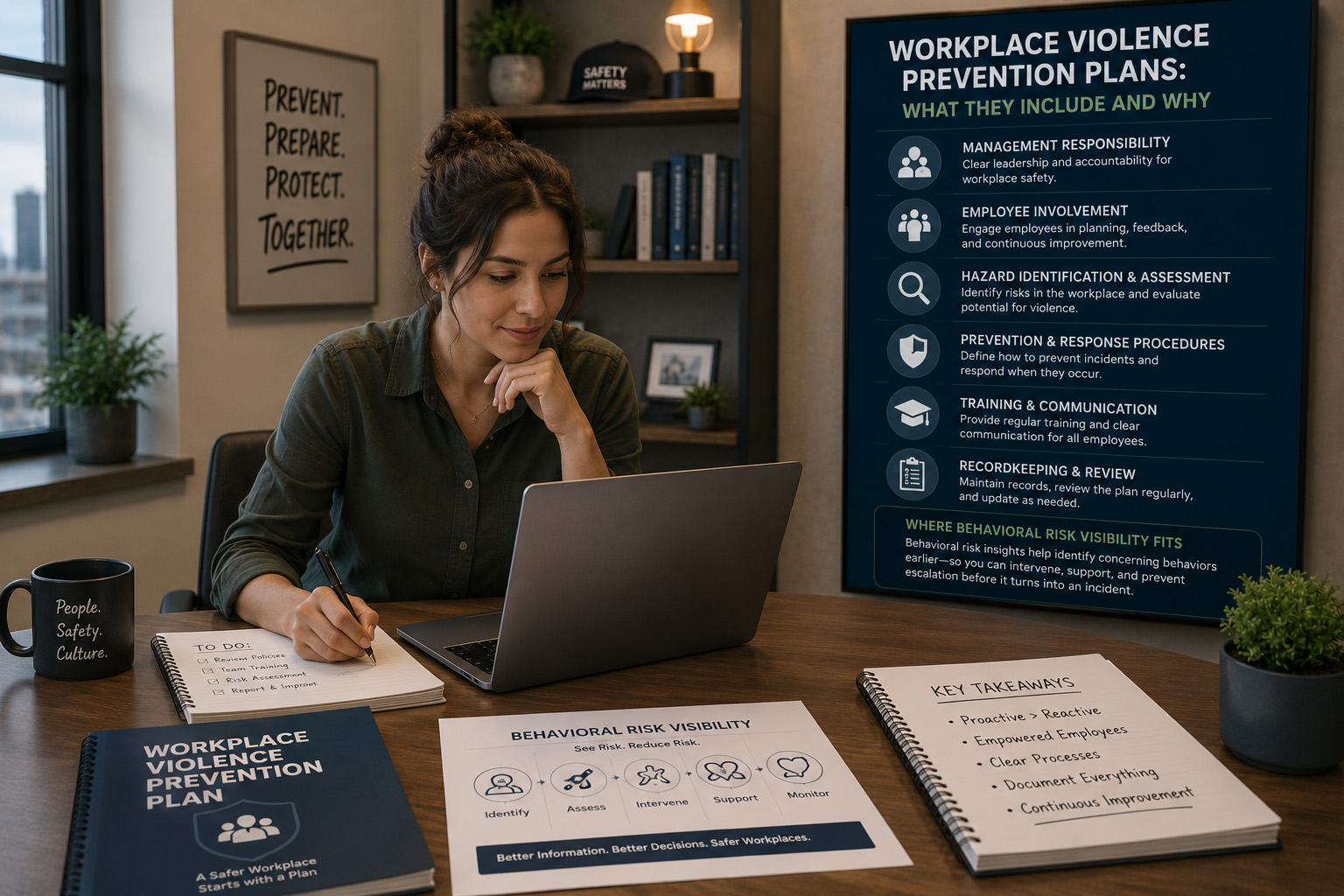

Short answer: A Workplace Violence Prevention Plan (WVPP) is a written program that sets out how an organization identifies, prevents, and responds to workplace violence. It typically covers who's responsible, how employees are involved, how hazards are identified and corrected, how incidents are reported and responded to, training, and recordkeeping. Some jurisdictions now require one—California being the most prominent example.
Workplace violence prevention has moved from best practice to legal requirement in a growing number of places. California's law (SB 553, in effect since mid-2024) is the most widely cited example, requiring most employers in the state to maintain a written WVPP. Even where a plan isn't legally mandated, the structure below reflects what a sound program generally includes. This is general information; confirm the requirements that apply to you with counsel and official sources.
What a WVPP generally includes
Whether required by law or adopted voluntarily, an effective written plan generally addresses:
- Responsibility. The names or job titles of the people responsible for implementing and maintaining the plan.
- Employee involvement. Procedures for involving employees (and their representatives, where applicable) in developing, implementing, and reviewing the plan.
- Coordination. Methods for coordinating the plan across locations and, where relevant, with other employers sharing a worksite.
- Compliance. Procedures to help ensure employees at all levels follow the plan.
- Communication. Clear, non-retaliatory ways for employees to report incidents and concerns.
- Emergency response. Procedures for responding to actual or potential workplace violence.
- Training. Effective, role-relevant training on recognizing and responding to workplace violence.
- Hazard identification and correction. Procedures to identify, evaluate, and correct workplace violence hazards.
- Incident response and recordkeeping. Procedures for responding to and investigating incidents, with records maintained—often including a log of violent incidents—and periodic review.
Most programs also call for reviewing the plan on a regular cadence and after any incident, new hazard, or significant operational change.
The common types of workplace violence
Programs frequently organize prevention around widely used categories of workplace violence:
- Criminal intent — the perpetrator has no legitimate relationship to the business (e.g., robbery).
- Customer or client — the perpetrator is a customer, client, patient, or visitor.
- Worker-on-worker — the perpetrator is a current or former employee.
- Personal relationship — the perpetrator has a personal relationship with an employee, such as domestic violence that follows someone to work.
Naming the categories helps a plan tailor its hazard identification and training to the risks a specific workplace actually faces.
Where behavioral risk visibility fits
Here's the honest framing, and it matters: behavioral or social media screening is generally not a required element of a workplace violence prevention plan. What plans typically require is a process to identify, evaluate, and correct workplace violence hazards—the hazard-identification element.
That's where behavioral risk visibility is relevant. Worker-on-worker and personal-relationship risks often leave documented traces in publicly available content before they escalate. Compliant social media screening—public content only, with protected-class redaction and human-adjudicated findings—can serve as one documented input into hazard identification. It supports that element; it doesn't satisfy a separate legal mandate, because there generally isn't one. Our complete guide to social media background checks explains how a compliant check works.
Used this way, screening is a hazard-identification input, documented and audit-ready, sourced from public content and handled consistently—strengthening the safety record without overstating what the law requires. For current employees, the same approach fits within an insider risk management program.
Building or auditing a plan
A practical sequence:
- Confirm what's required where you operate, and any exemptions that apply.
- Assign responsibility—name the person or role accountable.
- Build in employee involvement from the start, and document it.
- Establish hazard-identification, reporting, communication, emergency-response, and post-incident procedures.
- Train employees on the plan and the common types of workplace violence.
- Stand up incident recordkeeping.
- Review on a regular cadence and after any incident or change.
- Layer behavioral risk visibility into hazard identification as a documented input.
The bottom line
A sound Workplace Violence Prevention Plan is a written set of procedures—responsibility, involvement, hazard identification, response, training, and recordkeeping—reviewed regularly. Behavioral risk screening isn't typically on the required list, but it strengthens the hazard-identification element that is. Get the core elements right first; treat screening as the documented input that makes hazard identification more than a checkbox.
FAQ
What is a Workplace Violence Prevention Plan?
A written program setting out how an organization identifies, prevents, and responds to workplace violence—covering responsibility, employee involvement, hazard identification, response, training, and recordkeeping.
What does a WVPP typically include?
Responsibility, employee involvement, coordination, compliance procedures, communication, emergency response, training, hazard identification and correction, and incident response with recordkeeping and periodic review.
Is a WVPP legally required?
It depends on where you operate. A growing number of jurisdictions require one—California is the most prominent example. Confirm the requirements that apply to you.
Is social media screening required as part of a WVPP?
Generally no. Plans typically require hazard-identification procedures, which behavioral risk visibility can support as a documented input.
Related reading
- Insider risk management: where social media screening fits
- Negligent hiring: an employer liability guide
- Is social media screening legal? What employers need to know
Book a demo to see a sample Ferretly report.
This article is for general informational purposes only and is not legal advice. Requirements vary by jurisdiction. Consult qualified counsel and official sources for guidance specific to your organization.