Healthcare Background Checks: A 2026 Overview for Employers
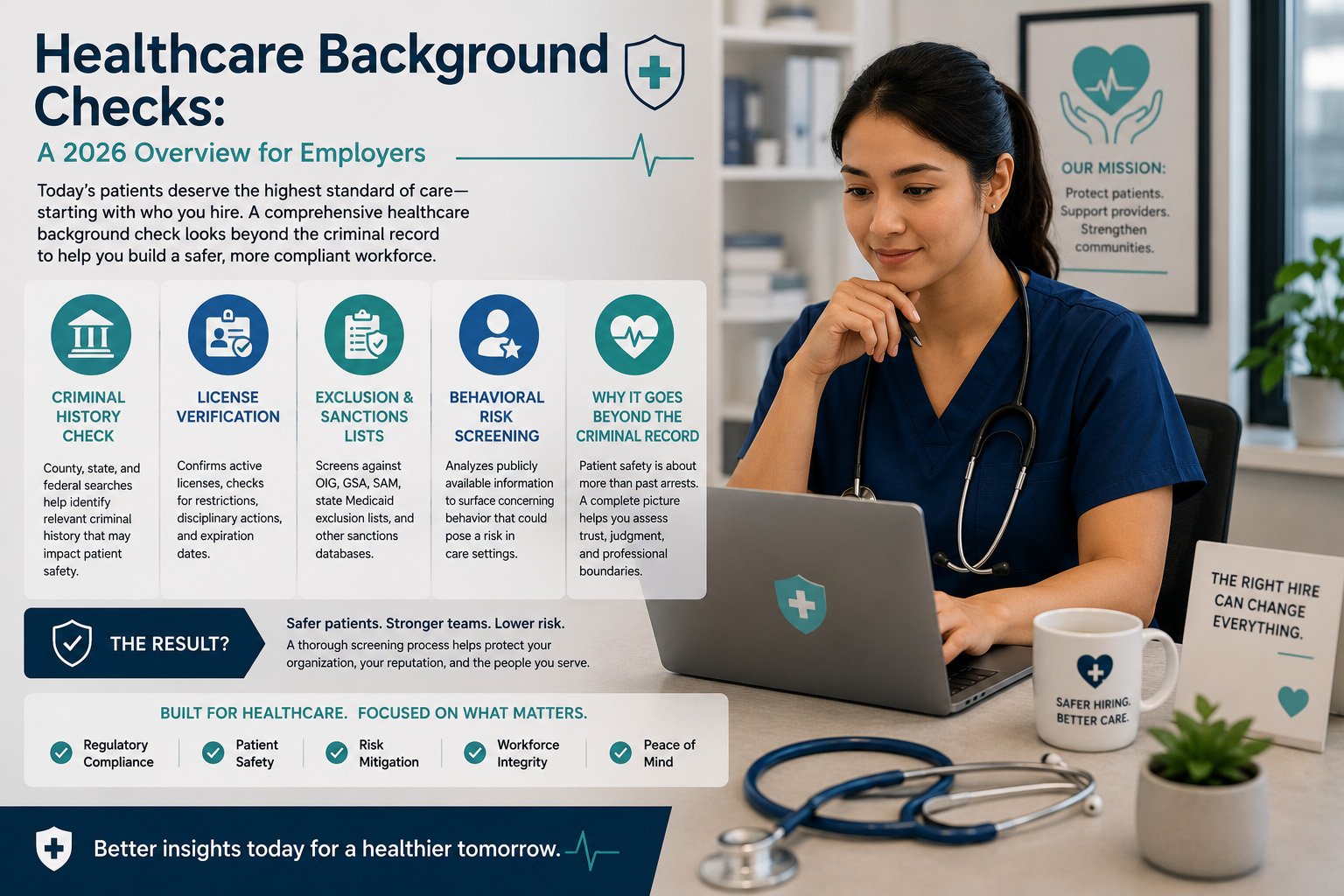

Short answer: Healthcare background checks typically combine several layers—criminal history, professional license verification, exclusion and sanctions screening, and increasingly behavioral risk in public content. The reason is patient safety: in healthcare, the cost of a missed risk isn't only legal, it's human. This overview explains the common layers and how they fit together.
Healthcare is one of the most heavily screened industries, and for good reason—staff work with vulnerable patients, controlled substances, and sensitive data. This guide covers the layers a healthcare screening program generally includes and where behavioral risk visibility fits. It's general information; confirm the specific requirements for your facility and roles with counsel and the relevant agencies.
Why healthcare screening goes deeper
Most industries screen to manage hiring risk. Healthcare screens to protect patients. That raises the stakes and broadens what a thorough program looks at. A criminal record check is the floor, not the ceiling—because much of what predicts risk in a care setting isn't an adjudicated crime. It's a license issue, an exclusion from a federal program, or a documented pattern of concerning conduct.
The common layers of a healthcare background check
A thorough healthcare screening program generally includes several layers:
- Criminal history. The foundation—county, state, and federal criminal records, appropriate to the role and jurisdiction.
- Professional license verification. Confirming that licenses and certifications are valid, current, and unencumbered, and checking for disciplinary actions through the relevant licensing boards.
- Exclusion and sanctions screening. Checking federal and state exclusion lists—such as the HHS Office of Inspector General exclusion list and the federal System for Award Management—to confirm an individual isn't barred from participating in federal healthcare programs. Industry databases that aggregate healthcare sanctions and disciplinary actions are often used to broaden this layer.
- Employment and education verification. Confirming credentials and work history, which matters acutely in clinical roles.
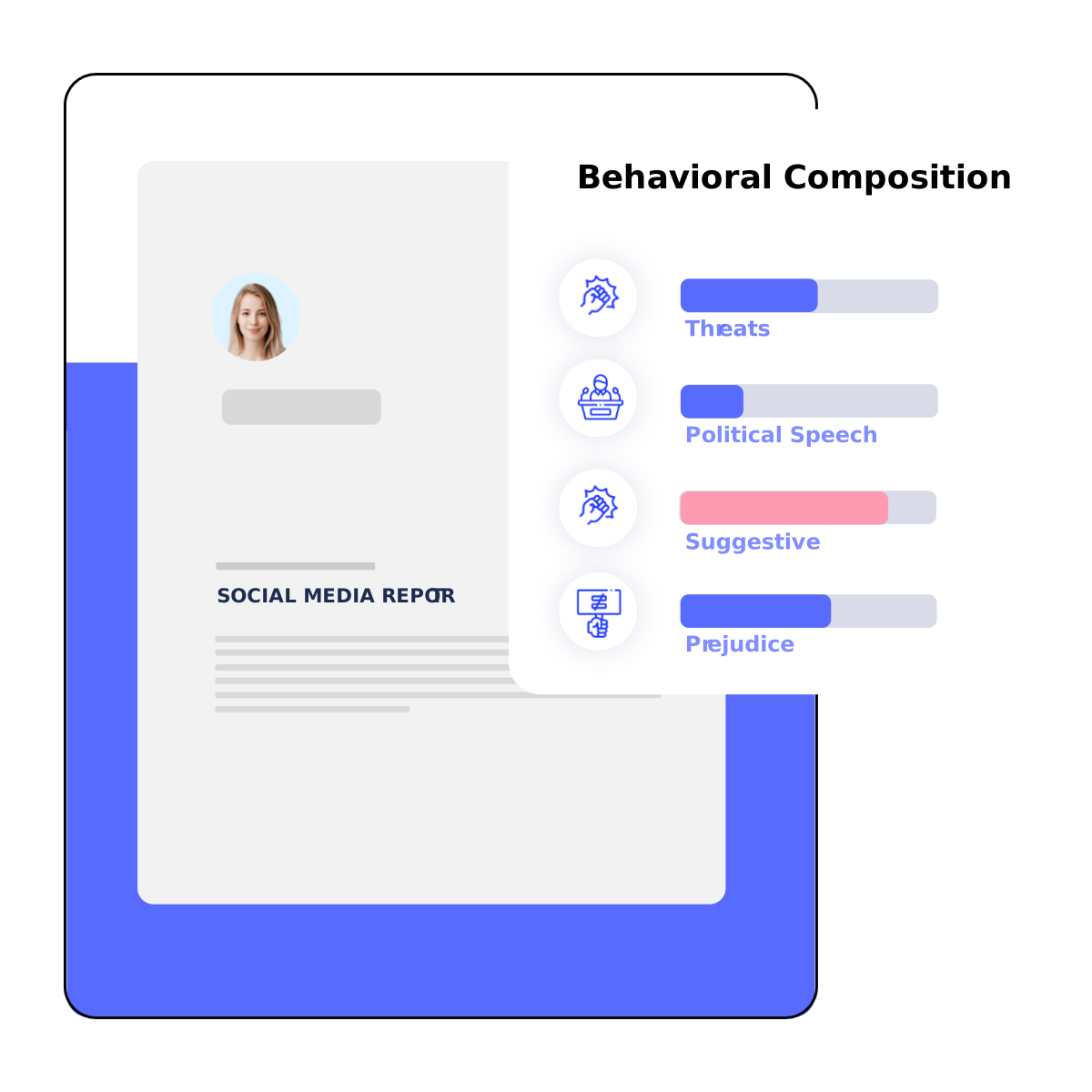
- Behavioral risk in public content. Documented patterns of violent, threatening, or concerning conduct in publicly available content that criminal and license checks won't surface.
Different roles call for different combinations. A clinician with prescribing authority, a home-health aide entering patients' homes, and a back-office administrator carry different risk profiles—and the screening should be matched to each.
Exclusion and sanctions screening, briefly
This layer is distinctive to healthcare. Federal and state programs maintain exclusion lists of individuals and entities barred from participation, and employing an excluded person in certain roles can carry serious consequences for a facility. Regular screening against these lists—often on an ongoing basis, not just at hire—is a standard part of healthcare compliance programs. Confirm the specific lists and cadence that apply to your facility with counsel.
Where behavioral risk screening fits
Criminal and license checks surface adjudicated history—charges, convictions, board actions. They don't surface behavioral signals: documented patterns of violent, harassing, or threatening conduct that may appear in public content before they ever reach a court or a licensing board.
In a patient-safety context, that gap matters. Compliant social media screening—public content only, with protected-class redaction and human-adjudicated findings—adds behavioral visibility to the picture. It's not a replacement for criminal or license checks; it's a complementary layer that catches a different kind of risk. As with every layer, the decision stays with the employer.
Building a healthcare screening program
A practical approach:
- Map roles to risk—clinical, patient-facing, prescribing, administrative.
- Set the criminal-history scope appropriate to each role and jurisdiction.
- Verify licenses and check for disciplinary actions through the relevant boards.
- Screen against exclusion and sanctions lists, with an ongoing cadence where appropriate.
- Verify employment and education for clinical roles.
- Add behavioral risk visibility from public content as a complementary layer.
- Keep the whole process documented and consistent.
The bottom line
Healthcare background checks are layered by necessity. Criminal history is the floor; license verification, exclusion and sanctions screening, and behavioral risk in public content build the rest. The organizing principle is patient safety—catching the range of risks a single check can't. Match the layers to the role, screen exclusion lists on an ongoing basis, and treat behavioral risk visibility as the layer that surfaces what the others miss.
FAQ
What does a healthcare background check include?Typically criminal history, professional license verification, exclusion and sanctions screening, employment and education verification, and increasingly behavioral risk in public content—matched to the role.
What are exclusion lists in healthcare screening?Federal and state lists of individuals and entities barred from participating in federal healthcare programs, such as the HHS OIG exclusion list. Facilities commonly screen against them on an ongoing basis.
Why does healthcare screening go beyond criminal checks?Because much of what predicts risk in a care setting isn't an adjudicated crime—it's a license issue, a program exclusion, or a documented pattern of concerning conduct.
How does social media screening fit into healthcare hiring?It's a complementary layer that surfaces behavioral signals in public content that criminal and license checks won't show—public content only, with protected-class redaction, and the decision left to the employer.
This article is for general informational purposes only and is not legal or compliance advice. Requirements vary by role, facility, and jurisdiction. Consult qualified counsel and the relevant agencies for guidance specific to your organization.