Is Social Media Screening Legal? A Plain-English Answer
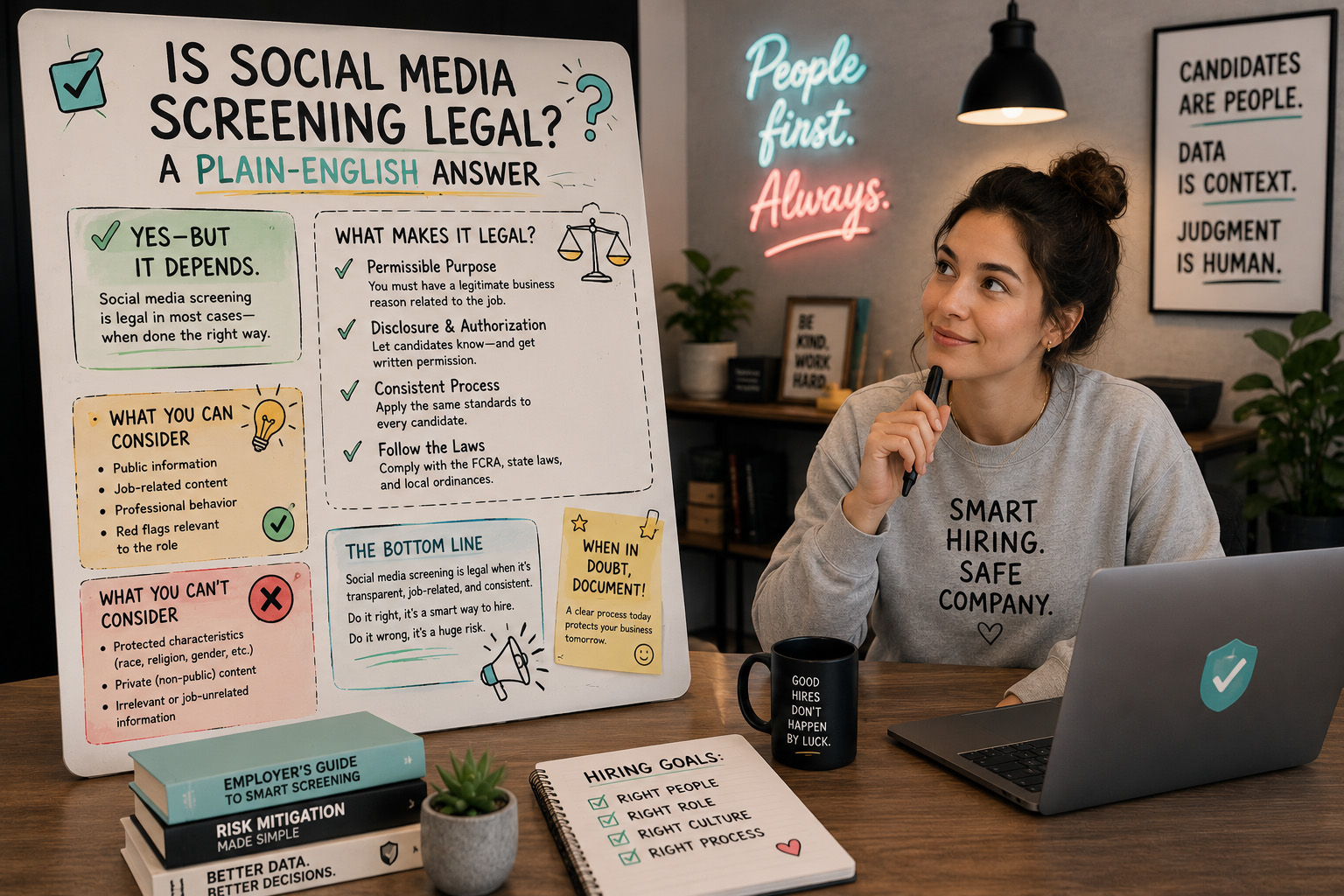

Short answer: In general, yes—reviewing publicly available social media is broadly permitted. The legality turns on how it's done. Done compliantly, social media screening uses public content only, removes protected-class information before review, follows the standard background-check process, and leaves the decision with the employer. Done casually, it can create privacy and discrimination risk.
"Is it legal?" is the wrong yes/no question. Social media screening is broadly permitted if a few conditions are met, and risky if they aren't. This guide lays out the conditions in plain English.
Yes, if the content is public
Reviewing content a person has chosen to make public is broadly permitted. What's restricted is demanding access to private accounts. Many states have laws restricting employers from requiring or requesting passwords or private-account access. A compliant process never asks for credentials and never accesses private accounts—it works from public content only. That single discipline keeps screening on the right side of these privacy laws.
Yes, if protected-class information stays out of the decision
Anti-discrimination laws—covering race, religion, age, disability, pregnancy, national origin, and more—apply to hiring decisions regardless of where the information comes from. Social media is unusually likely to expose protected-class information, which is the core legal risk of reviewing it casually.
The compliant answer is to remove that information before a decision-maker sees the file. Protected-class redaction means the review focuses on documented, job-relevant conduct, not on characteristics an employer can't lawfully consider.
Yes, if the background-check process is followed
When a third party conducts the screening for employment purposes, it generally falls within the standard background-check framework—meaning disclosure, written authorization, and a defined adverse action process if the employer acts on a finding. Following those steps consistently is part of what makes screening lawful in practice.
Yes, if the decision stays with the employer
Compliant providers return findings and categorizations—what was found in public content and how it's categorized—rather than a hire/no-hire recommendation. The employer makes the decision. That separation keeps the process defensible.
When it becomes risky
Social media screening drifts into risk when:
- A decision-maker informally browses a candidate's profile with no process
- Protected-class information is captured into the decision
- Private accounts are accessed or credentials are requested
- Keyword hits are treated as conclusions without context or adjudication
- No record exists of what was reviewed or why
In other words, the risk isn't social media screening itself—it's unstructured social media screening.
The compliant pattern, in one line
Public content only, protected-class information removed before review, standard background-check process followed, decision retained by the employer, and a documented audit trail throughout. An employer that meets those conditions is on solid footing. One that skips them is exposed—not because screening is illegal, but because the way it's being done is.
The bottom line
Is social media screening legal? Broadly, yes—when it uses public content, keeps protected-class information out of the decision, follows the background-check process, and leaves the decision with the employer. The legality lives in the method. A structured, documented process is both the compliant path and the defensible one.
FAQ
Is social media screening legal for employers?In general, yes—reviewing public content is broadly permitted. The key conditions are using public content only, keeping protected-class information out of the decision, and following the standard background-check process.
Can employers check your social media before hiring?They can review publicly available content. What's restricted in many states is demanding passwords or access to private accounts.
What makes social media screening non-compliant?Accessing private accounts, capturing protected-class information into the decision, treating keyword hits as conclusions, or skipping the background-check process.
Does social media screening follow the same rules as a background check?When a third party conducts it for employment purposes, it generally fits the same framework—disclosure, authorization, and adverse action steps.
This article is for general informational purposes only and is not legal advice. Laws vary by state and change over time. Consult qualified counsel for guidance specific to your situation.