State Social Media Password Laws: What They Actually Say (and What They Don't)
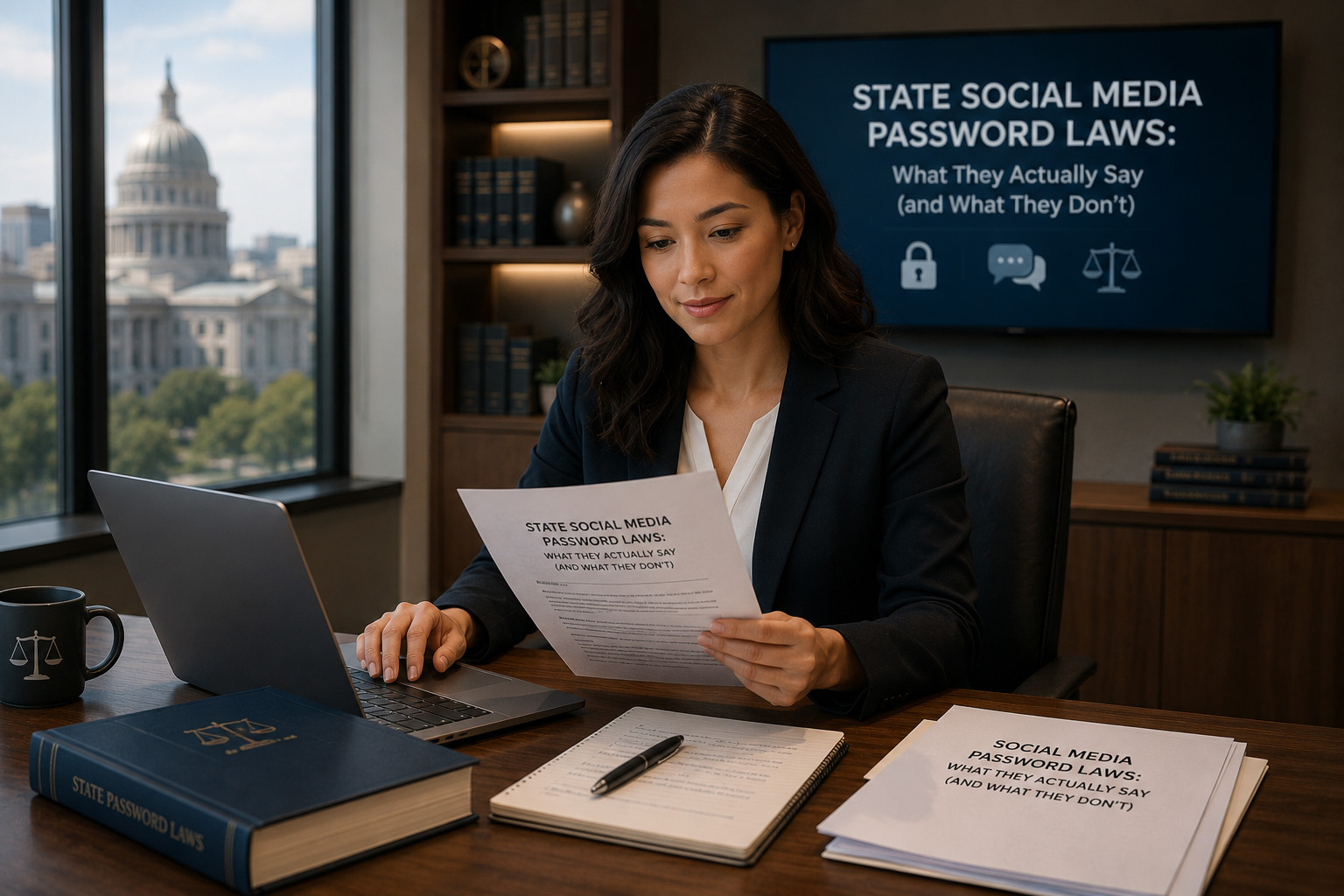

Short answer: State social media password laws generally restrict employers from demanding the usernames, passwords, or private-account access of applicants and employees. They do not prohibit reviewing what someone has posted publicly. The practical line is simple: public content is reviewable; private credentials are off-limits.
That distinction is the whole article. Much of the confusion around these laws comes from collapsing two very different things into one—demanding someone's password versus reading what they chose to make public. The first is restricted in a large share of states. The second is broadly permitted.
The misconception that's chilling legal hiring
A common belief sounds like this: "Several states made it illegal to look at a candidate's social media, so we don't touch it." That's not what these laws were written to do. They target a specific practice that drew attention years ago—employers asking applicants to hand over login credentials or to unlock private profiles during an interview. Lawmakers restricted that. They generally did not touch public posts.
So the effect is close to the opposite of what many HR teams assume. These laws actually clarify a defensible lane: review public content, never request credentials, never ask anyone to unlock a private account.
What these laws generally restrict
There is no single federal law on this point; the protections come from the states, and more than two dozen have enacted some version of them. The specifics vary, but across these states the laws commonly prohibit an employer from requiring or requesting that an applicant or employee:
- Disclose the username or password to a personal social media account
- Access a personal account in the employer's presence
- Change the privacy settings on a personal account
- Add the employer—or anyone—to their list of contacts or connections
- Disclose the contents of a private, password-protected account
Some states go further and restrict even suggesting these things, and several prohibit retaliation against someone who declines.
What these laws generally do not restrict
Here is the line that matters for hiring teams. These laws focus on private accounts—the password-protected layer a person has chosen not to make public. They generally do not reach content someone has published openly. Reviewing public posts, profiles, and openly shared content remains broadly permitted.
These laws also typically preserve an employer's ability to investigate specific, documented misconduct, and they generally do not apply to accounts the employer issued.
The compliant boundary stays clean: public content is reviewable; private credentials are not.
A consistent pattern, not 50 different rules
The details differ from state to state—definitions, exceptions, penalties—but the core structure is remarkably consistent. Nearly all of these laws restrict the same handful of behaviors above and leave public content untouched. For an employer operating in multiple states, that means one safe operating rule: build a process that only touches public information and never requests credentials.
How compliant social media screening stays inside the line
The defensible version of social media screening shares a few traits, and each maps onto what these laws are concerned with:
- Public content only. No credential requests, no access to private accounts, no asking a candidate to unlock anything.
- Protected-class information removed before review. A careful process redacts protected-class indicators so the review focuses on documented, job-relevant conduct.
- Human-adjudicated findings. The output is a set of findings and categorizations for the employer to weigh; the decision stays with the employer.
- Documented handling. A consistent, recorded process is what makes screening defensible.
None of that requires a password. That's the point.
The bottom line
State social media password laws are narrower than their reputation. They restrict demanding private credentials—and leave public-content review broadly intact. An HR team that treats "we can't look at social media" as settled law is leaving a defensible, documented screening lane on the table because of a misconception. The rule is simple: public content yes, passwords never.
FAQ
Is it illegal for employers to look at your social media?Generally no. Reviewing public social media content is broadly permitted. What many states restrict is requiring an applicant or employee to hand over passwords or unlock a private account.
Can an employer ask for your social media password?There's no single federal ban, but more than two dozen states restrict employers from requesting or requiring social media passwords or private-account access.
Do these laws ban social media background checks?Generally no. They focus on credential harvesting and private-account access. A social media check that uses only publicly available content operates differently.
What's the difference between public and private social media for screening?Public content is anything shared openly. Private content sits behind a password or privacy setting. These laws focus on the private layer; public content remains broadly reviewable.
This article is for general informational purposes only and is not legal advice. Laws vary by state and change over time. Consult qualified counsel and official sources for guidance specific to your situation.