Social Media Background Check: A Complete 2026 Guide for Employers


Short answer: A social media background check reviews a candidate's publicly available online content for job-relevant risk—violent, threatening, harassing, or illegal conduct—and returns documented, categorized findings. Done well, it uses public content only, removes protected-class information before anyone sees it, follows a consistent process, and leaves the hiring decision with the employer.
Most employers are already looking at candidates' social media. The real question isn't whether to do it—it's whether it's being done in a way that's consistent, documented, and defensible. This guide covers what a social media background check is, how a compliant one works end to end, what it can and can't consider, and how to tell a defensible process from a risky one.
What a social media background check is
A social media background check is a review of a person's publicly available online presence—posts, profiles, and openly shared content—conducted for a specific purpose such as employment. It's distinct from a criminal background check: a criminal check surfaces adjudicated legal history, while a social media check surfaces behavioral signals in public content that a criminal record won't show.
Two things define a compliant version: it uses public content only—no passwords, no private-account access—and it focuses on job-relevant risk, categorized, rather than collecting general information about someone's life.
What a compliant check looks for
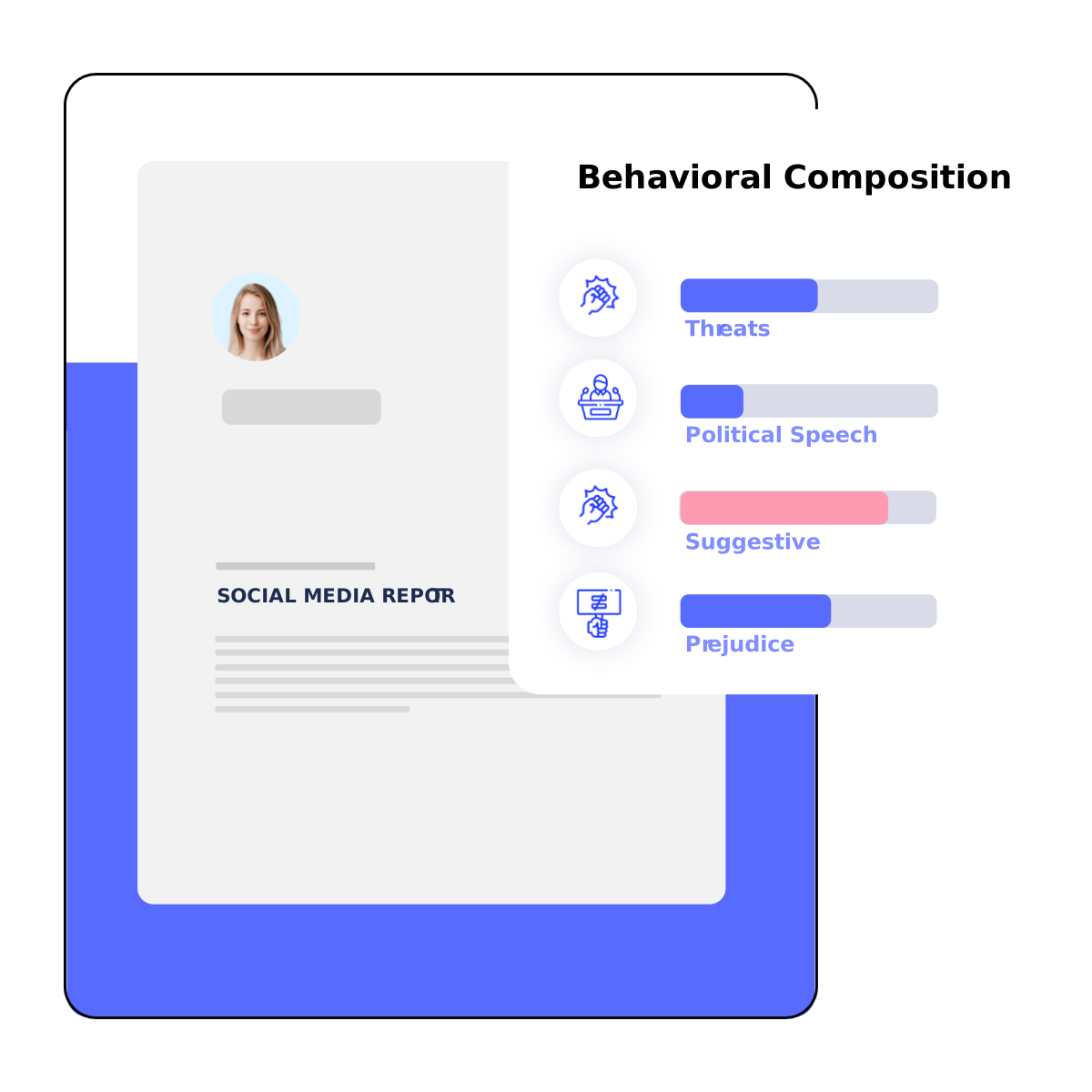
A defensible social media background check categorizes findings into job-relevant behavioral risk—violent or threatening content, harassing or discriminatory conduct, illegal activity, sexually explicit content, and similar—rather than returning a raw feed for someone to judge subjectively. The point is to focus on conduct an employer can appropriately consider, and to leave out everything else.
This is also what keeps a process clear of discrimination concerns. The risk of reviewing social media casually is that a decision-maker sees protected-class information—race, religion, age, disability, pregnancy, national origin—and a later question arises about whether it influenced the decision. A careful process removes that information before a human reviewer ever sees the file.
How a compliant check works
End to end, a defensible process generally runs like this:
- Disclosure and authorization. Because a third party is screening for employment purposes, the standard background-check framework applies—disclosure and written authorization before the check runs.
- Public content identification. The provider locates the subject's publicly available profiles and content using identity resolution—matching the right person to the right accounts from available identifiers, using public information only.
- Behavioral analysis. Public content is analyzed and categorized against defined risk classifications. Compliant providers pair automated analysis with human adjudication so a person stands behind the findings.
- Protected-class redaction. Protected-class indicators are removed before the report reaches any decision-maker.
- Findings and categorization. The output is a report of categorized findings tied to public sources—not a hire/no-hire recommendation. The decision stays with the employer.
- Adverse action, if applicable. If the employer considers acting on a finding, the standard adverse action steps apply.
That sequence is the difference between a defensible program and a manager scrolling a candidate's profile during lunch.
What can and can't be considered
The guardrails are consistent:
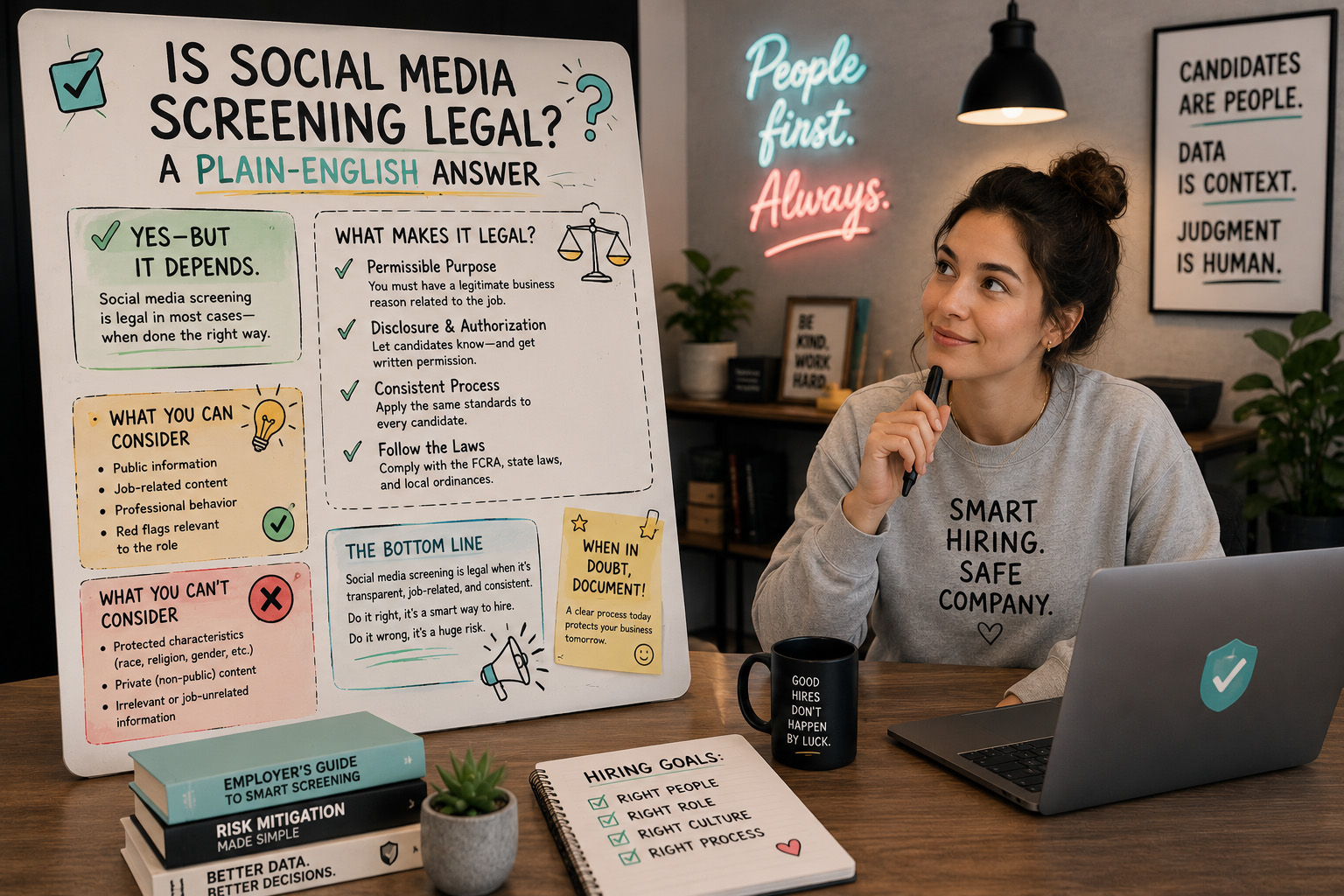
- Public content can generally be reviewed. Reviewing publicly available social media is broadly permitted.
- Private access generally cannot be demanded. Many states restrict requiring or requesting passwords or access to private accounts.
- Decisions can't be based on protected-class status. This is why pre-decision redaction matters.
- The background-check framework applies. When a third party screens for employment, disclosure, authorization, and adverse action steps come into play.
The compliant position is narrow and clear: public content, job-relevant categories, protected-class information removed, consistent process, decision retained by the employer.
Defensible vs. risky: how to tell
A defensible social media background check uses public content only, categorizes job-relevant risk, redacts protected-class indicators before review, pairs automation with human adjudication, follows a documented process, and produces an audit trail.
A risky one has a decision-maker informally browse a profile, captures protected-class information into the decision, treats keyword hits as conclusions, keeps no record of what was reviewed, and skips the standard process steps.
The capability difference is real, but the consistency difference is what shows up if a decision is ever questioned.
Where Ferretly fits
Ferretly is built for the defensible version. It's an AI-powered digital risk intelligence platform—paired with human adjudication and protected-class redaction—that analyzes publicly available content, categorizes behavioral risk, and returns findings and categorizations for the employer to weigh. The decision stays with the client. It also supports screening across a wide range of languages, which matters for multilingual workforces where an English-only review misses risk.
The bottom line
A social media background check is a behavioral-risk review of public content—useful precisely because it surfaces what a criminal check can't. The capability is straightforward; the discipline is everything. Public content only, job-relevant categories, protected-class redaction before review, human adjudication, consistent process, decision retained by the employer. An employer running that process has a defensible program. One skipping steps has a problem waiting to surface.
FAQ
What is a social media background check?A review of a candidate's publicly available online content for job-relevant behavioral risk, returning documented, categorized findings. A compliant check uses public content only.
Are social media background checks legal?Reviewing public social media content is broadly permitted. What's restricted is demanding passwords or private-account access, and making decisions based on protected-class status.
How is a social media check different from a criminal background check?A criminal check surfaces adjudicated legal history. A social media check surfaces behavioral signals—violent, threatening, or harassing conduct—in public content that a criminal record won't show.
How do social media checks avoid discrimination?A careful process redacts protected-class indicators before any decision-maker sees the file and categorizes only job-relevant conduct.
This article is for general informational purposes only and is not legal advice. Consult qualified counsel and official sources for guidance specific to your situation.