
Real-time screening against 1,000+ global sources for KYC/AML, investor due diligence, vendor onboarding and third-party risk — with behavioral risk in the same report.
Sanctions screening checks a person or organization against government and regulatory lists that restrict who a business is allowed to deal with — OFAC in the United States, the UN consolidated list, EU and UK lists, and others. It applies to customers, investors, vendors and employees alike. Screening usually runs at onboarding and then repeats, because a name that was clear last quarter may not be clear today.
Most programs pair sanctions checks with two related screens: politically exposed persons, who carry elevated bribery and corruption risk, and adverse media, which surfaces credible negative coverage that has not reached a formal list. Ferretly runs all three, and adds a fourth layer that list-based providers do not: what the subject has actually said and done in public.
Sanctions, watchlist and PEP data is drawn through the OpenSanctions API, which publishes its full source list openly, alongside Ferretly's own targeted searches across several hundred additional sites and its adverse media monitoring.
Screening draws on more than 1,000 sources across sanctions, watchlists, regulatory registers and adverse media. Source data refreshes on each publisher's own cadence — daily, weekly or monthly — and every check runs against the current data.
Being classified as a PEP is a risk category, not an allegation of wrongdoing.
Screen customers at onboarding and on an ongoing basis against sanctions, PEP and watchlist sources. Regulated firms carry the obligation whether or not the counterparty is a household name, and penalties attach to the institution rather than the analyst.
Before capital comes in, confirm the source is one the fund can accept. Sanctions exposure discovered after a close is materially harder to unwind than one found in diligence.
Suppliers, contractors and partners carry the same exposure as customers, and often get far less scrutiny. Screening at contract stage, then continuously, closes the gap most third-party risk programs leave open.
For roles with financial authority, security clearance or access to sensitive systems, sanctions and debarment checks sit alongside standard background screening.
A sanctions list is a record of something that already happened: a designation, a conviction, a regulatory action. It is necessary and it is backward-looking. Someone can clear every list on the day you screen them and still be a risk you would not accept if you could see what they post publicly.
Ferretly runs sanctions, PEP, debarment and adverse media screening inside the same report as its social media analysis. One subject, one pass, both kinds of risk: the formal record and the public behavior. For a compliance team, that means the violent rhetoric, the undisclosed business relationship or the public statement that contradicts a declaration shows up next to the list results rather than in a separate process that nobody runs.
List-only screening — catches designations, convictions, regulatory actions. Backward-looking by design.
Ferretly — the same list coverage, plus what the subject has said and done in public, analyzed across text, images and video in 230+ languages.
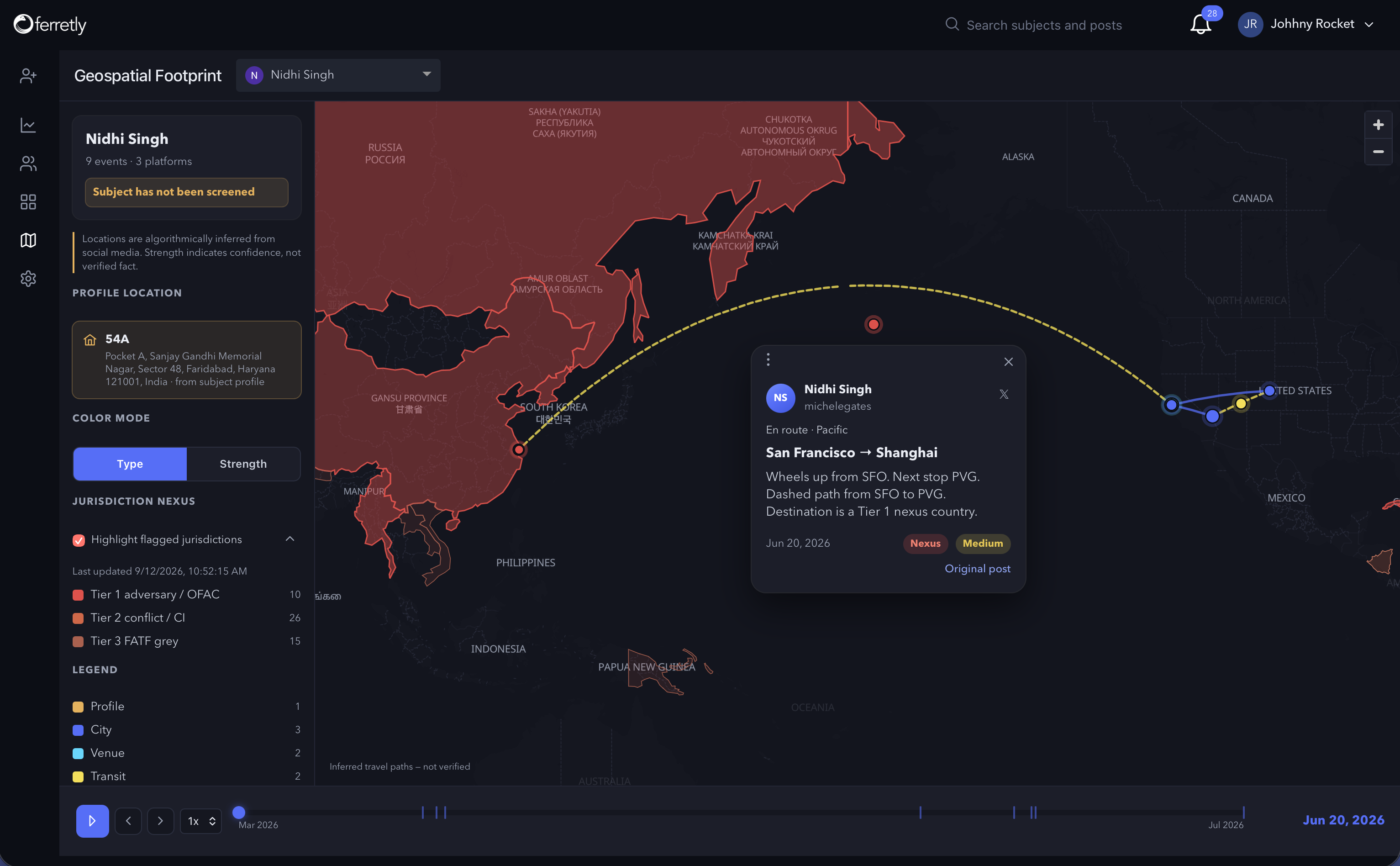
Sanctions matches appear inside the subject record, next to linked profiles and behavioral flags — one subject, one pass.
Designations change. A counterparty who cleared at onboarding can appear on a list eighteen months later, and the obligation does not wait for the next review cycle. Continuous screening rechecks your population on an ongoing basis and flags changes as they happen.
That is straightforward for fifty counterparties and a real operational problem for fifty thousand. Ferretly is built for volume: subjects added and run via API or import, and reporting that rolls up across an organization rather than arriving one report at a time.
One subject or a batch, added and run via API or import.
Sanctions, PEP, watchlist, debarment and adverse media run in real time, alongside behavioral analysis if enabled.
Matches arrive with the underlying source, so an analyst can clear or escalate rather than guess.
Ongoing rechecks flag changes after onboarding.
Subjects added and run via API or import, into the systems your team already uses.
Batch screening with per-report pricing and no platform fee.
Most reports return the same day.
Client and candidate data is never used to train AI models. That is an architectural boundary, not a policy preference. Full detail on our AI safety and security page.
Sanctions screening checks a person or organization against government lists that restrict who a business may deal with, including OFAC, the UN consolidated list, and EU and UK lists. Regulated firms screen customers as part of their compliance obligations, and many extend the same checks to investors, vendors and employees. Screening happens at onboarding and then repeats, because designations change.
Sanctions screening looks for people and entities a business is prohibited from dealing with. PEP screening identifies politically exposed persons, who are not prohibited but carry elevated bribery and corruption risk and usually require enhanced due diligence. Most compliance programs run both, along with adverse media.
Adverse media screening searches news and public sources for credible negative coverage about a subject, such as fraud allegations, investigations or regulatory action. It catches risk that has not yet reached a formal sanctions or watchlist entry, which is why it sits alongside list-based screening rather than replacing it.
Every reportable sanctions match is reviewed by a trained analyst before it reaches you. Name-based screening produces false matches constantly, because common names and transliterations collide, and most platforms hand the whole list to the client to sort out. Ferretly's analysts review global sanctions results as part of the standard process, so what arrives is a reviewed finding with its source attached rather than a queue of maybes.
Most programs screen at onboarding and then monitor on an ongoing basis, because a counterparty who clears today can be designated tomorrow. Continuous screening rechecks the existing population automatically and flags changes, rather than waiting for a periodic review.
It can, and increasingly it should. Suppliers, contractors and partners carry the same exposure as customers, and third-party risk programs often screen at contract signing and then never again. Ferretly screens vendors and third parties using the same sources as customer onboarding.
Ferretly screens the same sanctions, PEP, watchlist and debarment sources a dedicated provider does, and adds behavioral screening that list-based tools do not cover. Firms with an established screening provider often run Ferretly alongside it for the behavioral layer; firms building a program from scratch use it as their primary screen.
Yes. Ferretly runs sanctions, PEP, watchlist and adverse media screening inside the same report as its social media analysis, so formal record checks and public behavior appear together rather than in two separate processes.
No form, no email, no sales call. Look at a real report and decide from there.