The Digital Blind Spot: Why Social Media Screening Is the Growth Engine CRAs Are Missing in 2026


Written by Nick Fishman, Co-Founder, Partner IQubed Advisors
In the background screening industry, we throw around the word "comprehensive" a lot. We pull criminal records, verify employment and education history, run MVRs, and stitch it all into a single report.
But in 2026, can any background check honestly be called comprehensive if it ignores the digital footprint a candidate has spent the last decade building?
Social media screening is no longer a niche, "nice-to-have" line item. It's one of the fastest-growing background screening products on the market. For Consumer Reporting Agencies (CRAs), the question is no longer whether you should offer it. It's whether you can afford not to.
What Is Social Media Background Screening—and Why Does It Matter for CRAs?
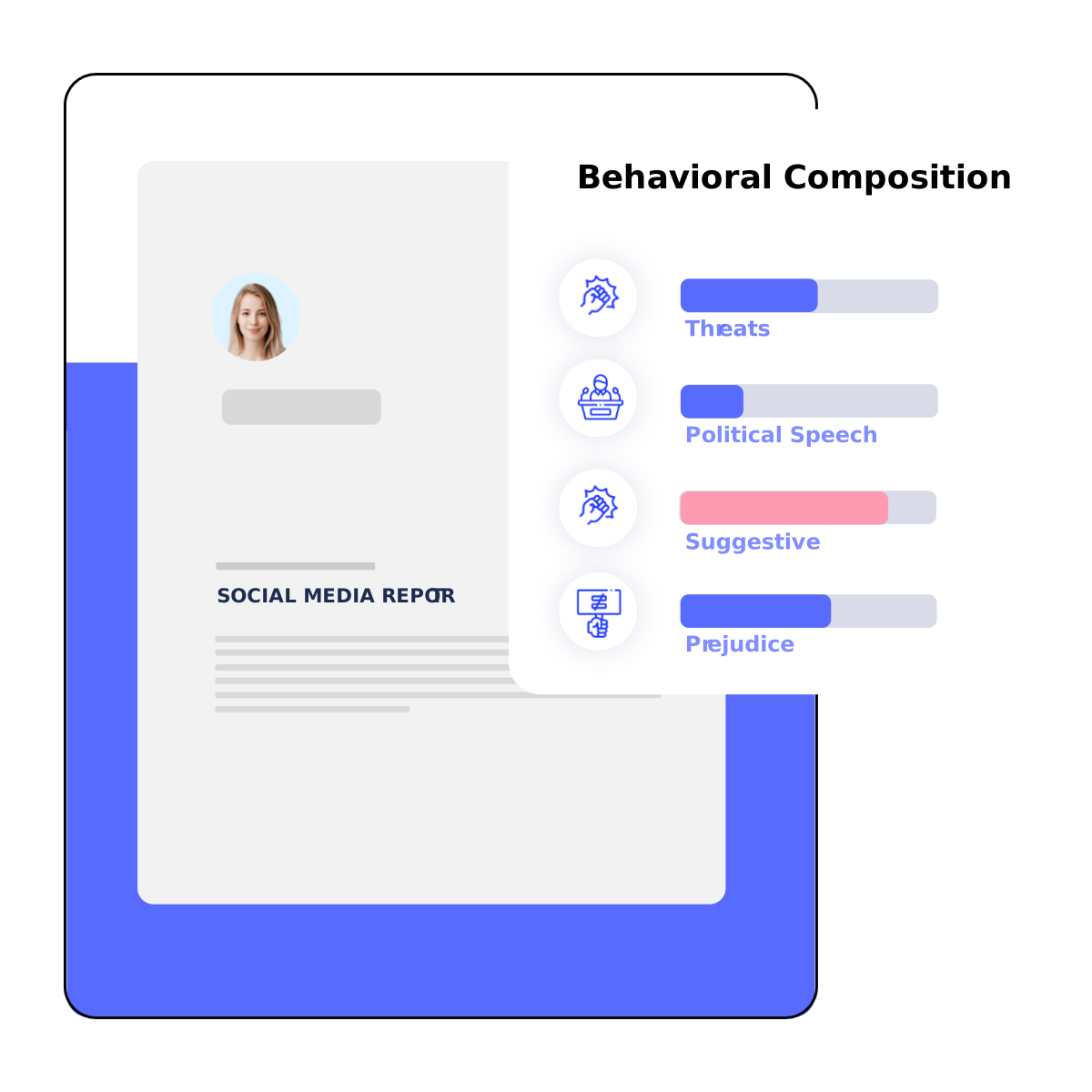
Social media background screening when done properly, is the systematic FCRA-compliant review of a candidate's publicly available online content—posts, images, video, and behavioral signals across major platforms—to identify job-relevant risks like violent ideation, hate speech, threats, drug-related activity, illegal behavior, and bullying.
What separates a real screening service from someone "Googling around" is the compliance architecture: protected class information (age, religion, disability, national origin) is filtered out before a reviewer ever sees it. The output is a defensible, FCRA consumer report—not a hiring manager's gut read.
We’ve reached a point where compliance requirements and revenue opportunity are finally aligned—a shift that most CRAs should be factoring into their 2026 planning.
Compressed Margins Are Real. Social Media Screening Is the Hedge.
The current landscape for CRAs is brutal. Between slower hiring cycles and the relentless race-to-the-bottom on pricing for traditional employment background screening solutions, margins are getting squeezed from both sides.
To stay profitable, you can no longer rely solely on high-volume, low-margin data. You need offerings with high perceived value and low operational friction.
Social media screening is exactly that. If you aren't selling it—as part of a core package or as a high-margin a la carte add-on—you are quite literally leaving revenue on the table.
Your Clients Are Already DIY-ing This (And Doing It Wrong)
The demand isn't theoretical. It's happening right now, with or without you.
Industry research shows that the majority of hiring managers already use social media to evaluate applicants. And because most CRAs haven't built this into their standard workflow, those managers are improvising—scrolling profiles manually, with zero legal or compliance guardrails.
That creates two problems your clients don't see until it's too late:
- Legal exposure. Manual social media review almost always surfaces protected class information—age, religion, disability, national origin, pregnancy, family status. Once a decision-maker has seen it, it becomes very hard to prove it didn't factor into a hiring decision. That's the foundation of an EEOC claim.
- Incomplete pictures. A manual scroll is subjective, inconsistent, and shallow. Hiring managers think they're getting the full picture. They're actually catching the loud red flags and missing the quieter patterns—coded language, signaled affiliations, video content that contradicts a candidate's stated history.
When that risk eventually shows up—and it does—the question your client will ask is: "Why didn't our background check catch this?"
You want a better answer than "you didn't order one."
The One-Stop-Shop Advantage
When a client can pull criminal, credit, identity, and behavioral insights from a single compliant report, churn drops dramatically. You stop being a data vendor and start being a strategic partner.
That's the durable version of this revenue: not the first sale, but the second, third, and fifteenth—without the procurement cycle.
How You Stack Up: 2026 Adoption Benchmarks
If you feel like you're hearing about social media screening more often, it's because your competitors are already moving:
- Roughly two-thirds of CRAs now offer social media screening as a service.
- Roughly half include it as a standard part of their everyday offering—not a special request or an exception.
If you're in the bottom third, the gap isn't closing on its own.
Why Partnering Is the Smarter Path to Profit
The biggest barrier for most CRAs has always been the fear of the manual deep dive. You don't want your staff burning hours on TikTok or Facebook trying to interpret context they aren't trained for.
This is where a partnership with a platform, like Ferretly changes the math. Their AI-driven screening doesn't just automate the heavy lifting—it removes the operational, compliance, and training burden that has kept most CRAs out of the category entirely.
Here's what changes when you stop manually screening and start partnering:

What's Next: Why the Risk Surface Just Got Bigger
Here's the part most CRA leaders haven't fully internalized yet.
Behavioral risk used to live in text posts. It doesn't anymore. It lives in TikTok videos, Instagram reels, livestream clips, and image content that traditional screening tools—built for the 2015 internet—simply can't read.
The platforms that will win this category aren't the ones running simple keyword scans on captions. My analysis shows that the industry is moving toward a much more sophisticated technical standard, characterized by:
• Multimedia Intelligence: Moving beyond text to perform frame-by-frame video and audio analysis to surface risks that text-based tools never see.
• Global Integrated Intelligence: Incorporating global sanctions and watchlist coverage (UN, OFAC, Interpol) directly into the behavioral report rather than treating them as separate products.
• Identity Resolution: Utilizing multi-agent systems to cross-reference data across platforms, which significantly reduces false positives and missed profiles.
Ferretly’s most recent platform updates are a prime example of this shift. By adopting these types of advanced capabilities, CRAs can move away from selling 2020-era checks and start providing a true 2026 risk mitigation shield.
Beyond the Tech: How to Choose the Right Partner
If you don't fully understand what you're selling, you can't sell it. To move from timid to top-performer in this category, you need more than a software login.
You need a strategic partner. When evaluating providers, look for three pillars:
- Training and enablement. Your partner should train your sales and support teams on how to position, sell, and service the product. Your reps should talk about social media risk with the same fluency as criminal records.
- Enterprise support. Look for a partner willing to roll up their sleeves on your larger opportunities—technical, subject-matter, and competitive support when the deal demands it.
- A regulatory shield. Compliance is the heartbeat of this industry. Make sure your partner has demonstrated fluency in the federal and state landscape—FCRA, EEOC, state-level social media laws—and operates strictly within it.
The Bottom Line
In a market defined by slower hiring and compressed margins, the only path forward is to deliver more value on every order you process. If you aren't actively selling social media screening, your clients are doing it themselves—badly, and potentially at the expense of their own organizations.
It's time to stop treating social media as an "extra" and start treating it as what it actually is in 2026: an essential risk mitigation tool and one of the most defensible revenue lines you can add to your book.
Frequently Asked Questions
What is social media background screening? Social media background screening is the FCRA-compliant review of a candidate's publicly available online content across major platforms—images, video, and text—to identify job-relevant risks such as violent ideation, hate speech, threats, illegal behavior, and bullying.Protected class information is filtered out before review.
Is social media screening FCRA-compliant? Yes—when conducted by a qualified CRA or screening partner. The FCRA governs how consumer reports are produced, used, and disputed. Reputable social media screening platforms like Ferretly operate within the FCRA framework, including disclosure, authorization, and adverse action requirements.
Can hiring managers do social media screening themselves? They can, but it's high-risk. Manual review by a hiring manager typically exposes them to protected class information (age, religion, disability, national origin) that can trigger EEOC discrimination claims. Using a third-party CRA partner provides a compliance buffer and a defensible audit trail.
What does an AI-driven social media background check actually scan? Modern platforms scan text posts, images, video content, and audio across major social platforms for job-relevant risks. Advanced platforms like Ferretly now offer frame-by-frame video analysis, global sanctions screening, and agentic identity resolution—categories of risk that text-only tools miss.
How can a CRA start offering social media screening? The most efficient path is partnering with a purpose-built provider rather than building the capability in-house. A good partner provides the technology, the compliance framework, and the training your sales and support teams need to position the product effectively.
Want to learn more about Ferretly and how social media screening can enhance your product offerings, book a live demo with Jaime today!
Orginally Published on IQubed Advisors May 12, 2026