FCA’s New Non-Financial Misconduct Rules Aren’t a Policy Update—They’re a System Reset

The quiet shift that just changed financial services risk models
In December 2025, the Financial Conduct Authority released Policy Statement PS25/23.
On paper, it’s about non-financial misconduct (NFM).
In reality, it redraws the boundary of what counts as regulatory risk.
For the first time, behavior outside the workplace—especially digital behavior—isn’t just reputational.
It’s regulatory.
And come September 1, 2026, firms won’t just be expected to react to misconduct.
They’ll be expected to detect it, document it, and defend how they handled it.
What actually changed (and why it matters more than people think)
PS25/23 integrates behavioral risk directly into:
- Conduct rules (COCON)
- Fitness & propriety assessments (FIT)
That sounds procedural. It’s not.
It means:
👉 A person’s pattern of behavior now impacts whether they are allowed to operate in the financial system.
👉 And firms are accountable for identifying that risk—before it becomes a problem.
The FCA is explicit:
Private social media activity can be relevant if it signals risk of harassment, violence, or regulatory breach.
Translation for operators:
Your risk surface just expanded beyond your walls.
The real unlock: behavior is now a measurable risk signal
Historically, firms assessed:
- Credit history
- Criminal records
- Certifications
Clean inputs. Structured data. Easy to audit.
Now?
You’re being asked to assess:
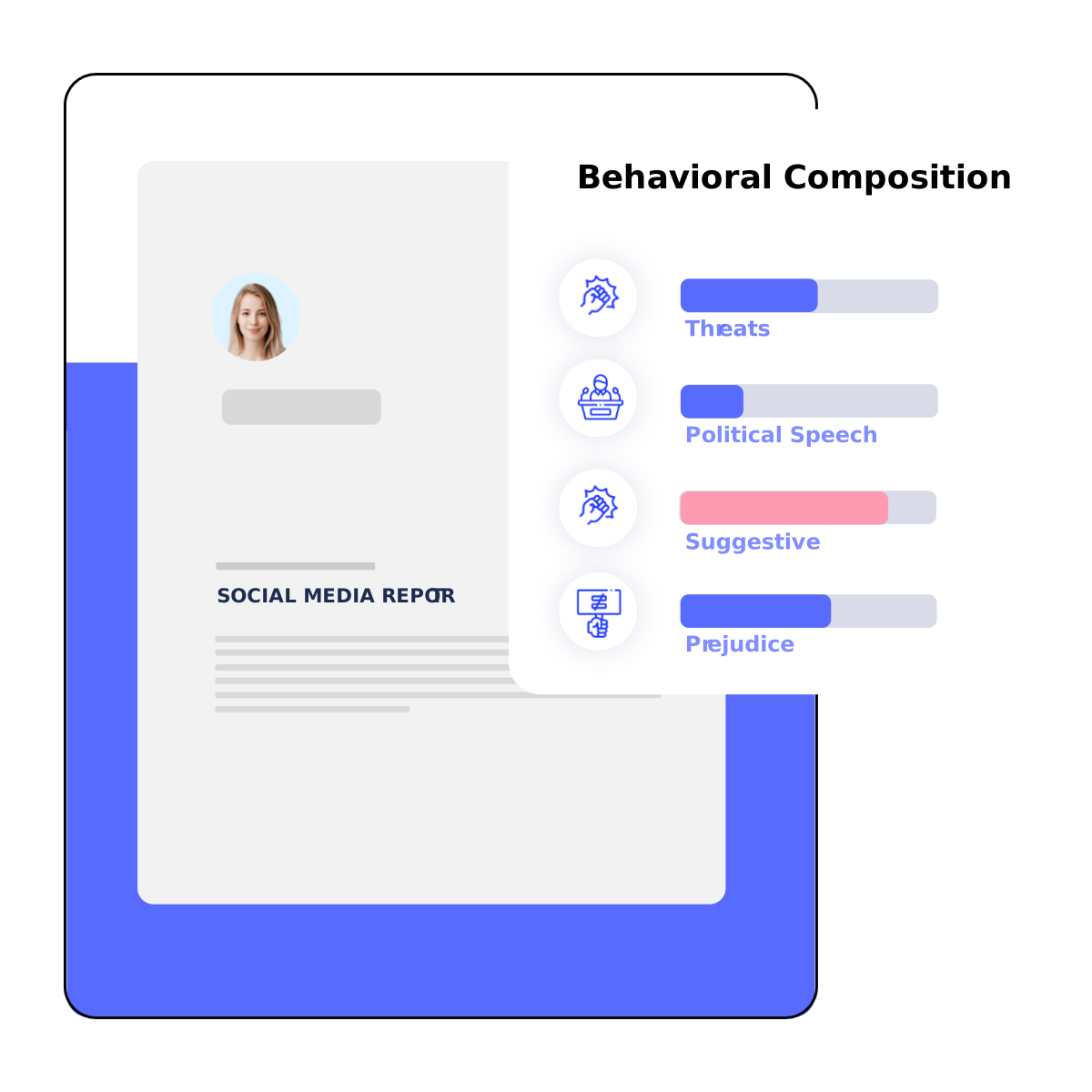
- Harassment
- Threats
- Discrimination
- Patterned toxic behavior
- Escalation signals across digital environments
That’s not structured.
That’s behavioral intelligence.
And here’s the uncomfortable truth most vendors won’t say out loud:
👉 Most compliance teams are not equipped for this shift.
Where most firms will fail (and regulators will notice)
Let’s call it straight.
When regulation moves faster than infrastructure, teams default to:
1. Manual review (“just Google them”)
- Inconsistent
- Impossible to scale
- Completely indefensible in an audit
2. Overreach
- Flagging protected characteristics
- Crossing privacy boundaries
- Creating legal exposure while trying to reduce risk
3. No audit trail
- No documentation of how decisions were made
- No consistency across hires or reviews
- No ability to defend outcomes to regulators
This is where PS25/23 gets real:
👉 It’s not just about what you find
👉 It’s about how you found it—and whether you can prove it
The new requirement: defensible behavioral screening
FCA didn’t just expand scope.
They implicitly introduced a new standard:
Behavioral risk must be:
- Consistent
- Explainable
- Relevant to role
- Documented for audit
That’s a completely different operating model.
Where Ferretly fits (and why this isn’t just “screening”)
This is where we take a different stance than the rest of the market.
Ferretly isn’t here to “scan the internet.”
That’s table stakes—and frankly, where most risk is introduced.
We focus on something much more important:
👉 Turning unstructured behavior into structured, defensible insight
What that looks like in practice:
1. Behavior-first detection (not keyword scraping)
We identify patterns tied to:
- Harassment
- Disparaging speech
- Threats
- Discrimination
- Escalation risk
Aligned to what regulators actually care about—not noise.
2. Explainable outputs (built for audit, not curiosity)
Every finding is:
- Contextualized
- Categorized
- Reviewable by humans
Because if you can’t explain it, you can’t defend it.
3. Compliance-aligned boundaries
We do not surface:
- Protected class inference
- Personal opinions outside risk relevance
Because screening should reduce risk—not create it.
4. A consistent, repeatable framework
Every candidate. Every employee. Same standard.
That’s what regulators expect.
That’s what most firms don’t have.
The bigger picture: this is about trust infrastructure
The FCA isn’t trying to monitor people’s lives.
They’re doing something bigger:
👉 Rebuilding trust in financial systems through behavioral accountability
And that puts firms in a new position:
You are no longer just employers.
You are gatekeepers of integrity.
What to do before September 2026
If you’re in financial services, the move now is simple—but not easy:
1. Audit your current screening process
- Are you capturing behavioral risk at all?
- Is it consistent?
- Could you defend it in front of a regulator?
2. Define your internal adjudication framework
- What constitutes risk?
- What triggers escalation?
- How do you ensure fairness?
3. Implement a scalable, compliant system
Because this is not something you can duct-tape together.
Bottom line
PS25/23 didn’t just introduce new guidance.
It introduced a new expectation:
👉 Behavior is now part of compliance.
The firms that treat this like a checkbox will struggle.
The ones that operationalize it will have an advantage—not just with regulators, but with trust, hiring, and long-term brand equity.