The 2026 Employer's Guide to Public Digital Behavior

In 2026, HR isn’t just evaluating candidates. They’re evaluating character values.

The 2026 Employer's Guide to Public Digital Behavior

The 2026 Employer’s Guide to Public Digital Behavior

Why Social Media Screening Has Become HR’s New Risk Perimeter

There’s a tectonic shift happening in hiring. Not loud. Not flashy. But unavoidable.

For the first time in workforce history, the most revealing signals about a person’s professionalism, judgment, and risk profile aren’t living inside resumes, criminal databases, or reference checks. They’re living in the open — on the very platforms billions use every day.

Not in private messages.

Not behind logins.

But in the public behaviors people voluntarily attach to their names.


In 2026, HR isn’t just evaluating candidates. They’re evaluating the judgment, values, and risk indicators candidates broadcast across TikTok, Instagram, LinkedIn, Reddit, and emerging platforms. Recent studies now show that 91% of employers believe social media screening reveals information traditional background checks miss, and many say it directly helps prevent reputational risk.

And that’s why “social media background checks” — once treated like a nice-to-have — have evolved into a risk perimeter for any employer concerned with safety, culture, brand reputation, and public trust.

But here’s what most employers miss: social media screening in 2026 isn’t your IT team Googling a name. Professional behavioral-intelligence platforms now use AI to review years of public posts, identifying risk patterns human reviewers would never catch — from workplace hostility indicators to compliance threats to patterns of aggression.

A quick scroll, a gut check, a “vibe”? That era is gone.

Risk has evolved.

Reputation has evolved.

Technology has evolved.

Hiring practices haven’t kept up.

That must change.

1. Why Public Digital Behavior Matters Now

People have always revealed themselves — but in the last five years, how they reveal themselves has changed.

Today, public posts function as workplace predictors.

When a candidate shares public content such as:

  • cheering violence
  • mocking protected classes
  • posting sexually explicit or harassing material
  • expressing hostility toward coworkers, customers, or entire groups

…it’s no longer “their personal life.”

It’s a public act tied to their identity — easily discoverable by customers, coworkers, students, patients, or reporters.

And when something goes wrong?

Screenshots move faster than HR can say, “Please reach out to our communications team.”

In 2026, public digital behavior isn’t an opinion.

It’s a risk surface.

Employers aren’t trying to police lifestyle.

They’re trying to avoid the #1 HR nightmare:

the preventable headline.

2. The Collapse of the Public–Professional Divide

Let’s get real: the separation between “who I am at work” and “who I am online” is gone.

Case 1: The Principal Who Thought a Meme Was Harmless

A middle-school principal posted a meme mocking a protected group. Parents surfaced it. Local news amplified it. The district scrambled. The resignation landed in 24 hours — not because someone snooped, but because it was public.

Case 2: The Nurse With a TikTok Problem

A pediatric nurse with a spotless license made TikTok jokes about medicating “difficult parents.” Not illegal. Not smart. A parent found the videos after treatment. Trust dissolved overnight.

Case 3: The Delivery Driver With Online Rage

Criminal record? Clean. Driving record? Clean.

Public posts? Months of violent rants.

Once a customer complaint went viral, the company looked negligent — even though they followed all traditional screening processes.

3. The Myth of “Traditional Background Checks Are Enough”

Most background checks surface:

  • criminal records
  • licenses
  • employment history
  • education
  • driving history

All important.

All incomplete.

Because modern workplace risk doesn’t live in databases.

It lives in:

  • comments
  • screenshots
  • reposts
  • usernames
  • memes
  • photos
  • public digital patterns

Traditional background checks show what someone has done.

Public digital behavior shows who someone chooses to be in public.

It’s not about perfection.

It’s about predictability, professionalism, and alignment.

4. Why DIY Screening Is a Legal Minefield (and a Reputation Bomb)

When a recruiter Googles a candidate, they will — without meaning to — see:

  • age
  • religion
  • disability
  • pregnancy
  • politics
  • sexual orientation
  • health status
  • protected lifestyle details

Even if they don’t use that information…

They can’t prove they didn’t.

DIY screening creates:

  • unintentional bias
  • inconsistent decisions
  • zero defensibility
  • major privacy concerns
  • candidate mistrust

From a candidate’s perspective, DIY screening feels like surveillance.

From an employer perspective, it creates legal exposure.

Everyone loses.

5. The New HR Risk Perimeter: Identity + Context + Behavior

Modern public behavior screening is no longer “searching someone’s Facebook.”

It’s a discipline built on three pillars:

1. Identity Accuracy

Who does the content actually belong to?

  • No false matches
  • No assumptions
  • No “same name on Twitter” errors

Identity resolution is a science.

2. Contextual Relevance

Is the behavior:

  • job-relevant?
  • risk-relevant?
  • recent?
  • connected to workplace safety or conduct?

Or is it protected personal identity?

Context is everything.

3. Behavioral Categorization

Not “bad posts.” Not “offensive jokes.”

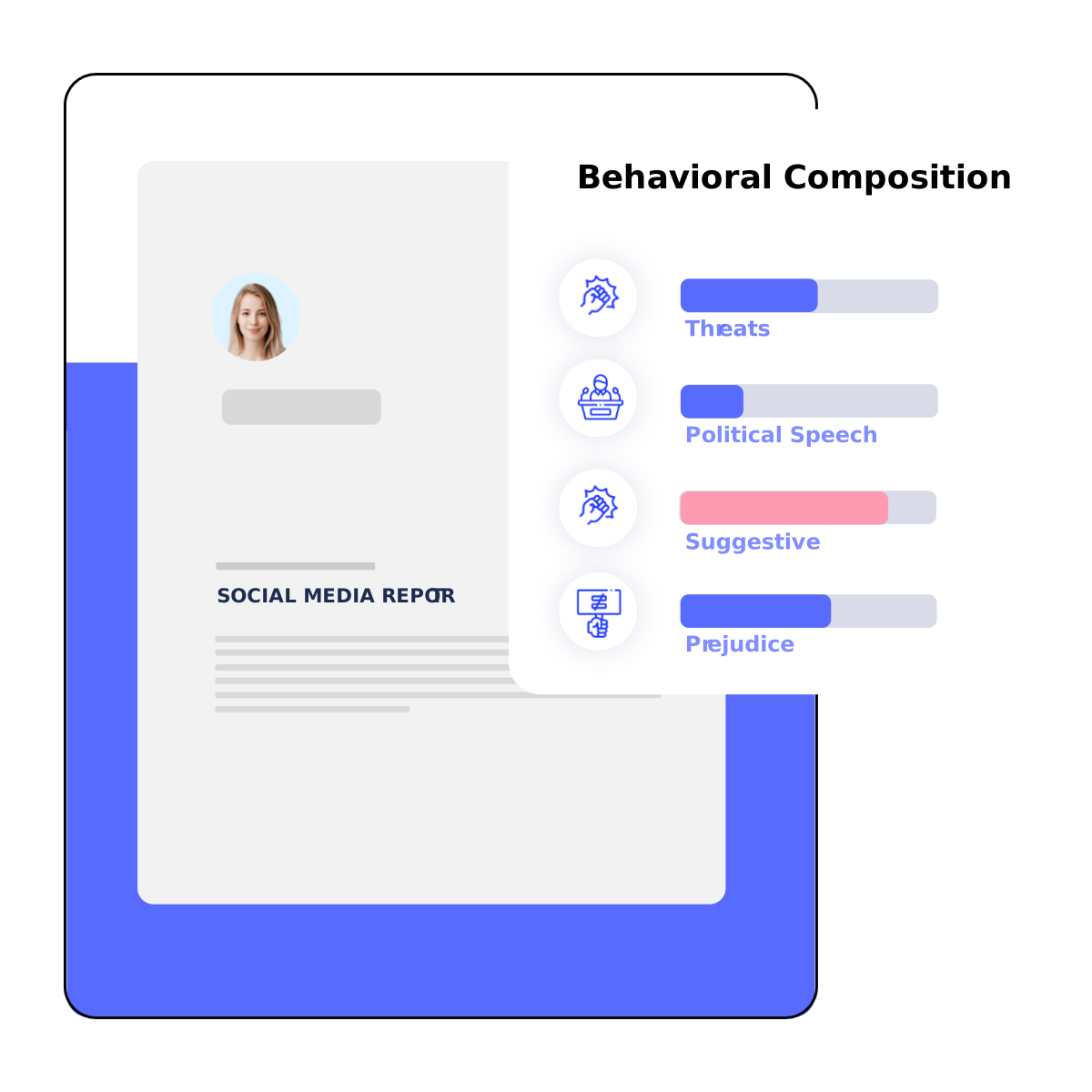
Modern screening focuses only on professional risk indicators:

  • violent threats
  • harassment
  • patterns of intolerance
  • illegal acts
  • explicit public conduct
  • workplace hostility
  • stalking, doxxing, or digital aggression

These are not political.

They’re behavioral.

6. Why Context Matters More Than Ever

Two people can post the same image and signal completely different things.

  • A clinician sharing an explicit case for training
  • A teenager reposting the same content as a meme
  • A candidate using dark humor
  • A filmmaker sharing horror effects work
  • An activist sharing news footage

Context determines:

  • severity
  • intent
  • relevance
  • workplace impact

Without context, you get mischaracterizations that damage employer brand and push away great candidates.

7. What Candidates Think (and Why It Matters)

Candidates aren’t afraid employers will find “bad posts.” They’re afraid employers will find:

  • the wrong account
  • content missing context
  • old posts from teenage years
  • creative work misinterpreted as harmful
  • sarcastic posts misread by an algorithm

Candidates don’t fear fairness.

They fear misattribution.

And that fear is justified — because many screening tools still over-flag or lack nuance.

Fairness isn’t just ethical in 2026.

It’s a competitive hiring advantage.

8. The Future: Public Digital Behavior as Workforce Intelligence

We’re entering a new era where:

  • transparency is the norm
  • reputation moves across platforms
  • digital footprints function as public signals
  • AI amplifies visibility
  • trust becomes a strategic asset

The employers who thrive will be the ones who understand:

Public digital behavior isn’t a punishment.

It’s a pattern.

It reveals how someone communicates, reacts, and represents themselves publicly.

Workplaces don’t need perfection.

They need:

  • judgment
  • respect
  • stability
  • alignment
  • trustworthiness

The fundamentals of safe, productive teams.

9. What Ethical, Modern Screening Actually Looks Like

A privacy-forward approach follows a simple philosophy:

Only look at what’s public.

Only surface what’s job-relevant.

Only flag what’s risk-indicative.

Never touch protected information.

And it must follow:

  • FCRA
  • EEOC
  • NLRA
  • state privacy and password laws
  • informed consent
  • required adverse action sequence

Anything outside this is not screening.

It’s surveillance.

10. The Bottom Line: This Is About Trust

In 2026, trust is the currency of every workforce.

Trust in leadership.

Trust in coworkers.

Trust in culture.

Trust in workplace safety.

Trust in brand reputation.

Public digital behavior screening isn’t about punishing opinions or identity. It’s about preventing:

  • violence
  • harassment
  • reputational crises
  • toxic patterns
  • preventable HR disasters

It’s about ensuring workplaces stay:

  • safe
  • compliant
  • respectful
  • resilient
  • aligned with their mission

All without crossing privacy boundaries or misjudging people based on incomplete information.

That’s the new perimeter.

That’s the new standard.

That’s where responsible employers are heading.

FAQ

1. What is public digital behavior in hiring?

Public digital behavior refers to the publicly visible online actions, posts, comments, photos, and interactions a candidate has attached to their name. Employers use it to understand judgment, professionalism, and potential workplace risk.

2. Is reviewing social media during hiring legal in 2026?

Yes — if it follows FCRA, EEOC, NLRA, state privacy laws, and only includes publicly available, job-relevant information. Employers cannot use protected-class details to make decisions.

3. What risks do social media background checks help identify?

Modern screening uncovers risk indicators such as violent threats, harassment, intolerance, explicit public content, illegal activity, and workplace hostility — all of which traditional background checks miss.

4. What’s the difference between DIY screening and a compliant social media check?

DIY screening exposes employers to legal risk, bias, and protected information. A compliant third-party screening uses identity matching, context evaluation, human review, and only surfaces risk-relevant behavior.

5. How far back should social media screening go?

Most employers focus on recent, relevant behavior. Ethical screening platforms emphasize context, recency, job relevance, and avoid outdated, irrelevant, or protected personal history.

The 2026 Employer's Guide to Public Digital Behavior

Vous souhaitez consulter un exemple de reportage sur les réseaux sociaux ?

Planifiez une démonstration gratuite

The 2026 Employer's Guide to Public Digital Behavior

Learn why public digital behavior is now HR’s top risk perimeter. A 2026 guide to safe, compliant, ethical social media screening for modern employers.

The 2026 Employer’s Guide to Public Digital Behavior

Why Social Media Screening Has Become HR’s New Risk Perimeter

There’s a tectonic shift happening in hiring. Not loud. Not flashy. But unavoidable.

For the first time in workforce history, the most revealing signals about a person’s professionalism, judgment, and risk profile aren’t living inside resumes, criminal databases, or reference checks. They’re living in the open — on the very platforms billions use every day.

Not in private messages.

Not behind logins.

But in the public behaviors people voluntarily attach to their names.


In 2026, HR isn’t just evaluating candidates. They’re evaluating the judgment, values, and risk indicators candidates broadcast across TikTok, Instagram, LinkedIn, Reddit, and emerging platforms. Recent studies now show that 91% of employers believe social media screening reveals information traditional background checks miss, and many say it directly helps prevent reputational risk.

And that’s why “social media background checks” — once treated like a nice-to-have — have evolved into a risk perimeter for any employer concerned with safety, culture, brand reputation, and public trust.

But here’s what most employers miss: social media screening in 2026 isn’t your IT team Googling a name. Professional behavioral-intelligence platforms now use AI to review years of public posts, identifying risk patterns human reviewers would never catch — from workplace hostility indicators to compliance threats to patterns of aggression.

A quick scroll, a gut check, a “vibe”? That era is gone.

Risk has evolved.

Reputation has evolved.

Technology has evolved.

Hiring practices haven’t kept up.

That must change.

1. Why Public Digital Behavior Matters Now

People have always revealed themselves — but in the last five years, how they reveal themselves has changed.

Today, public posts function as workplace predictors.

When a candidate shares public content such as:

  • cheering violence
  • mocking protected classes
  • posting sexually explicit or harassing material
  • expressing hostility toward coworkers, customers, or entire groups

…it’s no longer “their personal life.”

It’s a public act tied to their identity — easily discoverable by customers, coworkers, students, patients, or reporters.

And when something goes wrong?

Screenshots move faster than HR can say, “Please reach out to our communications team.”

In 2026, public digital behavior isn’t an opinion.

It’s a risk surface.

Employers aren’t trying to police lifestyle.

They’re trying to avoid the #1 HR nightmare:

the preventable headline.

2. The Collapse of the Public–Professional Divide

Let’s get real: the separation between “who I am at work” and “who I am online” is gone.

Case 1: The Principal Who Thought a Meme Was Harmless

A middle-school principal posted a meme mocking a protected group. Parents surfaced it. Local news amplified it. The district scrambled. The resignation landed in 24 hours — not because someone snooped, but because it was public.

Case 2: The Nurse With a TikTok Problem

A pediatric nurse with a spotless license made TikTok jokes about medicating “difficult parents.” Not illegal. Not smart. A parent found the videos after treatment. Trust dissolved overnight.

Case 3: The Delivery Driver With Online Rage

Criminal record? Clean. Driving record? Clean.

Public posts? Months of violent rants.

Once a customer complaint went viral, the company looked negligent — even though they followed all traditional screening processes.

3. The Myth of “Traditional Background Checks Are Enough”

Most background checks surface:

  • criminal records
  • licenses
  • employment history
  • education
  • driving history

All important.

All incomplete.

Because modern workplace risk doesn’t live in databases.

It lives in:

  • comments
  • screenshots
  • reposts
  • usernames
  • memes
  • photos
  • public digital patterns

Traditional background checks show what someone has done.

Public digital behavior shows who someone chooses to be in public.

It’s not about perfection.

It’s about predictability, professionalism, and alignment.

4. Why DIY Screening Is a Legal Minefield (and a Reputation Bomb)

When a recruiter Googles a candidate, they will — without meaning to — see:

  • age
  • religion
  • disability
  • pregnancy
  • politics
  • sexual orientation
  • health status
  • protected lifestyle details

Even if they don’t use that information…

They can’t prove they didn’t.

DIY screening creates:

  • unintentional bias
  • inconsistent decisions
  • zero defensibility
  • major privacy concerns
  • candidate mistrust

From a candidate’s perspective, DIY screening feels like surveillance.

From an employer perspective, it creates legal exposure.

Everyone loses.

5. The New HR Risk Perimeter: Identity + Context + Behavior

Modern public behavior screening is no longer “searching someone’s Facebook.”

It’s a discipline built on three pillars:

1. Identity Accuracy

Who does the content actually belong to?

  • No false matches
  • No assumptions
  • No “same name on Twitter” errors

Identity resolution is a science.

2. Contextual Relevance

Is the behavior:

  • job-relevant?
  • risk-relevant?
  • recent?
  • connected to workplace safety or conduct?

Or is it protected personal identity?

Context is everything.

3. Behavioral Categorization

Not “bad posts.” Not “offensive jokes.”

Modern screening focuses only on professional risk indicators:

  • violent threats
  • harassment
  • patterns of intolerance
  • illegal acts
  • explicit public conduct
  • workplace hostility
  • stalking, doxxing, or digital aggression

These are not political.

They’re behavioral.

6. Why Context Matters More Than Ever

Two people can post the same image and signal completely different things.

  • A clinician sharing an explicit case for training
  • A teenager reposting the same content as a meme
  • A candidate using dark humor
  • A filmmaker sharing horror effects work
  • An activist sharing news footage

Context determines:

  • severity
  • intent
  • relevance
  • workplace impact

Without context, you get mischaracterizations that damage employer brand and push away great candidates.

7. What Candidates Think (and Why It Matters)

Candidates aren’t afraid employers will find “bad posts.” They’re afraid employers will find:

  • the wrong account
  • content missing context
  • old posts from teenage years
  • creative work misinterpreted as harmful
  • sarcastic posts misread by an algorithm

Candidates don’t fear fairness.

They fear misattribution.

And that fear is justified — because many screening tools still over-flag or lack nuance.

Fairness isn’t just ethical in 2026.

It’s a competitive hiring advantage.

8. The Future: Public Digital Behavior as Workforce Intelligence

We’re entering a new era where:

  • transparency is the norm
  • reputation moves across platforms
  • digital footprints function as public signals
  • AI amplifies visibility
  • trust becomes a strategic asset

The employers who thrive will be the ones who understand:

Public digital behavior isn’t a punishment.

It’s a pattern.

It reveals how someone communicates, reacts, and represents themselves publicly.

Workplaces don’t need perfection.

They need:

  • judgment
  • respect
  • stability
  • alignment
  • trustworthiness

The fundamentals of safe, productive teams.

9. What Ethical, Modern Screening Actually Looks Like

A privacy-forward approach follows a simple philosophy:

Only look at what’s public.

Only surface what’s job-relevant.

Only flag what’s risk-indicative.

Never touch protected information.

And it must follow:

  • FCRA
  • EEOC
  • NLRA
  • state privacy and password laws
  • informed consent
  • required adverse action sequence

Anything outside this is not screening.

It’s surveillance.

10. The Bottom Line: This Is About Trust

In 2026, trust is the currency of every workforce.

Trust in leadership.

Trust in coworkers.

Trust in culture.

Trust in workplace safety.

Trust in brand reputation.

Public digital behavior screening isn’t about punishing opinions or identity. It’s about preventing:

  • violence
  • harassment
  • reputational crises
  • toxic patterns
  • preventable HR disasters

It’s about ensuring workplaces stay:

  • safe
  • compliant
  • respectful
  • resilient
  • aligned with their mission

All without crossing privacy boundaries or misjudging people based on incomplete information.

That’s the new perimeter.

That’s the new standard.

That’s where responsible employers are heading.

FAQ

1. What is public digital behavior in hiring?

Public digital behavior refers to the publicly visible online actions, posts, comments, photos, and interactions a candidate has attached to their name. Employers use it to understand judgment, professionalism, and potential workplace risk.

2. Is reviewing social media during hiring legal in 2026?

Yes — if it follows FCRA, EEOC, NLRA, state privacy laws, and only includes publicly available, job-relevant information. Employers cannot use protected-class details to make decisions.

3. What risks do social media background checks help identify?

Modern screening uncovers risk indicators such as violent threats, harassment, intolerance, explicit public content, illegal activity, and workplace hostility — all of which traditional background checks miss.

4. What’s the difference between DIY screening and a compliant social media check?

DIY screening exposes employers to legal risk, bias, and protected information. A compliant third-party screening uses identity matching, context evaluation, human review, and only surfaces risk-relevant behavior.

5. How far back should social media screening go?

Most employers focus on recent, relevant behavior. Ethical screening platforms emphasize context, recency, job relevance, and avoid outdated, irrelevant, or protected personal history.