Show Me the Signal: Consumer Reporting Agencies


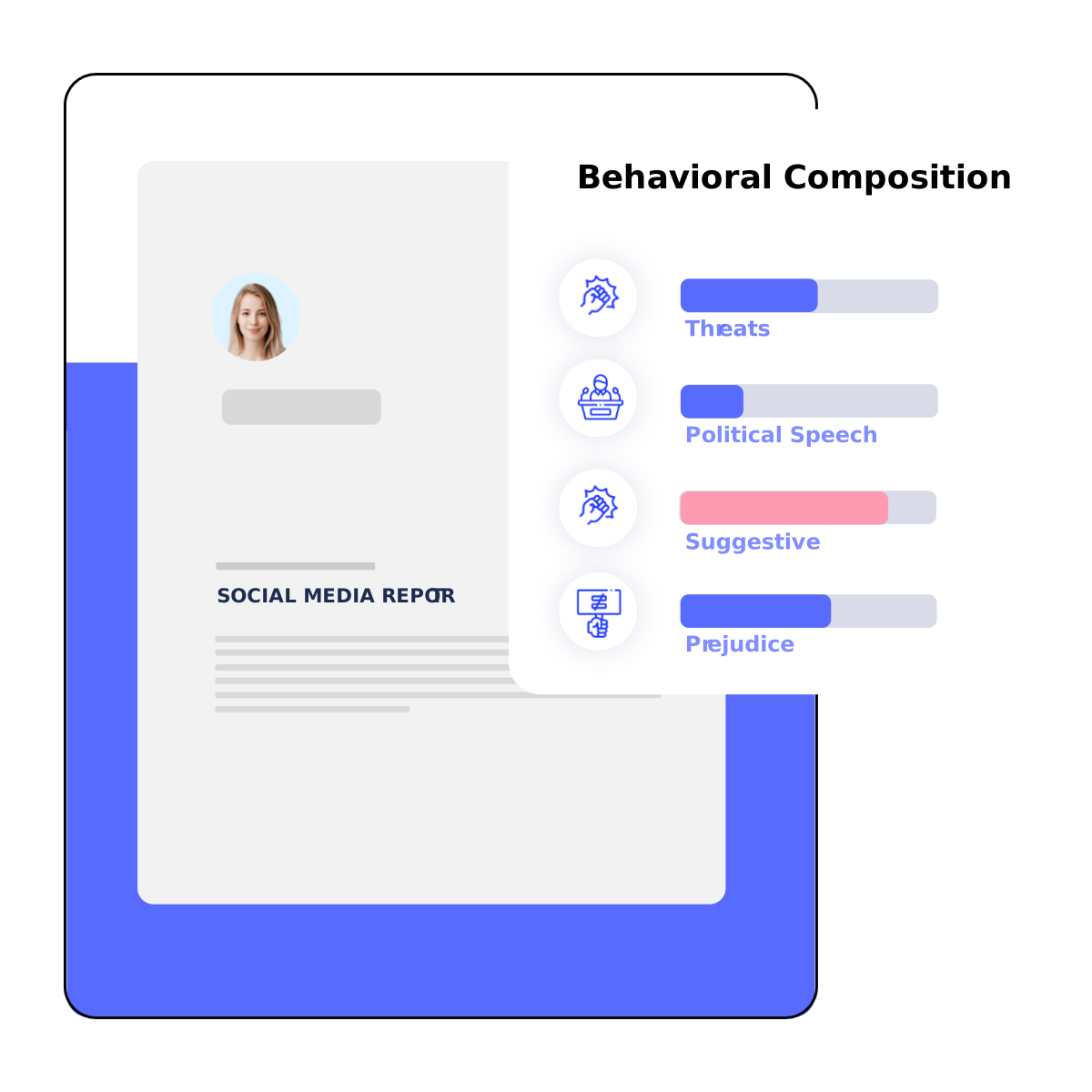
Recent advances in AI-driven technology have allowed companies to analyze public digital data on personal social media accounts, gathering basic information like age, national origin,and religion.
Beyond basic information, public digital data, made available through personal social media accounts, canindicate:
• Modes of living
• Interests and hobbies
• Corporate and organizationalaffiliations
• Political and social beliefs
• Property ownership
• Discriminatory beliefs
With the recent shift of basing credit scores and related financial decisions on nonfinancial factors, social media analysis on consumers can provide further insights and data points. Although this data is public, Consumer Reporting Agencies cannot use it freely under the Fair Credit Reporting Act.
Behavioral Insights
Public digital data can increase your understanding of someone's behavioral patterns. Posts, comments, likes, and other forms of engagement are all social signals that indicatethe person's level of online activity.
From these behaviors, agencies can better estimate their stability or risk. People also chose to present themselves in a certain way online, manifesting through what they chose toshare about themselves.
Data on this can help agenciesinfer their level of trustworthiness or responsibility.
Lifestyle Insights
People may post about a wide variety of things, but Consumer Reporting Agencies should take special consideration for posts about spending habits, travel, or large purchases.These posts can indicate the financial health of the person.
Additionally, who the person engages with on social media platforms can be telling. For example, if the person consistently engages with financial services or banks through social media, they may be more financially literate and knowledgeable.
If the person engages with alumni associations or with a specific school, they may be indicating their student history.
Sentiment Analysis
Public digital data on social media can help reflect a person's emotional state and opinions on certain topics. AI analytics on accounts can help derive a sentiment analysis.
A person's history of negative posts surrounding financial matters could indicate financial stress, whereas positive posts could indicate credit worthiness.
For example, if an individual posts frequent complaints about overdue bills or shut off utilities, they maybe under financial strain. Financial distress signals, particularly posts about financial hardship, can indicate to Consumer Reporting Agencies that the personis of higher risk.
Identity Verification
With the improvements of content, fraud is becoming a different kind of threat to financial agencies. Social media analysis can help prevent fraud by cross referencing many data points.
By using AI to take and analyzedata from many social media platforms, agencies can validate someone's identityby confirming basic information like their name, location, and picture.
How does social media analysis comply with consumer privacy regulations?
Consumer Reporting Agencies are required to comply with the Fair Credit Reporting Act, which means that they are bound to the same rules as traditional background screening companies.
AI leveraged technology is anew development, but it must still comply with the Fair Credit Reporting Act, which can be difficult to navigate since not all public data is allowed to be used.
Which is why we Ferretly was built.
How can Ferretly help?
Ferretly produces these insights in a socially responsible manner, while remaining compliant with themany regulations on consumer privacy.
Transparency and Ethics are Key
Ferretly provides documentation throughout the entire analysis process and does not store consumer data beyond what is necessary for reporting.
Additionally, we keep humanityin the process through oversight of the AI produced analytics: Ferretly leaves human rationale and decision making in control.
Our AI completes the gruntwork, while humans provide next level analytics and conclusions.
The Bottom Line
AI-driven analytics on public digital data can help bolster reports by Consumer Reporting Agencies. Ferretly helps to ensure that these analytics are handled with the highestethical standards and strictest compliance with consumer protectionregulations.
###
About This Article
This piece was developed as part of a University of Maryland writing practicum exploring AI ethics, responsible AI-assisted content creation, and advanced prompting techniques. The course was led by Adam Lloyd, Ph.D., with industry mentorship provided by Ferretly to ground coursework in real-world application and ethical AI use.
Student Author: Elanor Kim
→ekim0914@terpmail.umd.edu · LinkedIn
Course Faculty & Mentorship
Adam Lloyd, Ph.D. · Lecturer, University of Maryland
Adam teaches business and technical writing with a focus on real-world application—his courses partner with companies to create actual workplace deliverables. He co-created UMD's "Digital Rhetoric at the Dawn ofExtra-Human Discourse," exploring AI's role in academic, creative, and professional writing. A former journalist, startup founder, and award-honored educator, he holds advanced degrees in English, philosophy, and national security studies.
→lloyda@umd.edu · LinkedIn
Nicole Young · VP, Growth Marketing
Nicole provides industry mentorship for this course, bringing deep experience in growth marketing, advertising strategy, and AI-integrated content systems. Her work focuses on building ethical, scalable marketing programs at the intersection of technology, trust, and brand performance. She welcomes collaboration with academic programs seeking practitioner partnerships.
→nicole@ferretly.com · LinkedIn