Is it Really AI Screening vs. Human Creativity?


Would Quentin Tarantino have passed a modern AI screening?
Let's begin.
Do AI screenings flag eccentric or unconventional behavior as risk signals – potentially halting new creativity? Tarantino and other influential producers are famously unconventional, yet that very nonconformity often drives their originality.Some of the most iconic films began as bold, even controversial ideas that only a boundary-pushing creator could imagine.
AI screenings are advancing every day, bringing sharper nuance to individual evaluations. It's crucial thatAI can distinguish between promising creativity and genuinely problematic behavior. Production companies thrive on out-of-the-box thinkers whose digital footprints may be long, messy, or odd. AI already compiles information quickly; the real challenge is how it interprets that information so that we don't lose brilliant minds in the process.
1. The Rise of AI in Creative Recruitment
Tensions rise when"AI" and "creativity" appear side by side, because recruiting creative talent demands a different, more sensitive lens. Production roles carry enormous influence, and those behind them shape culture – meaning thorough, thoughtful vetting is essential.
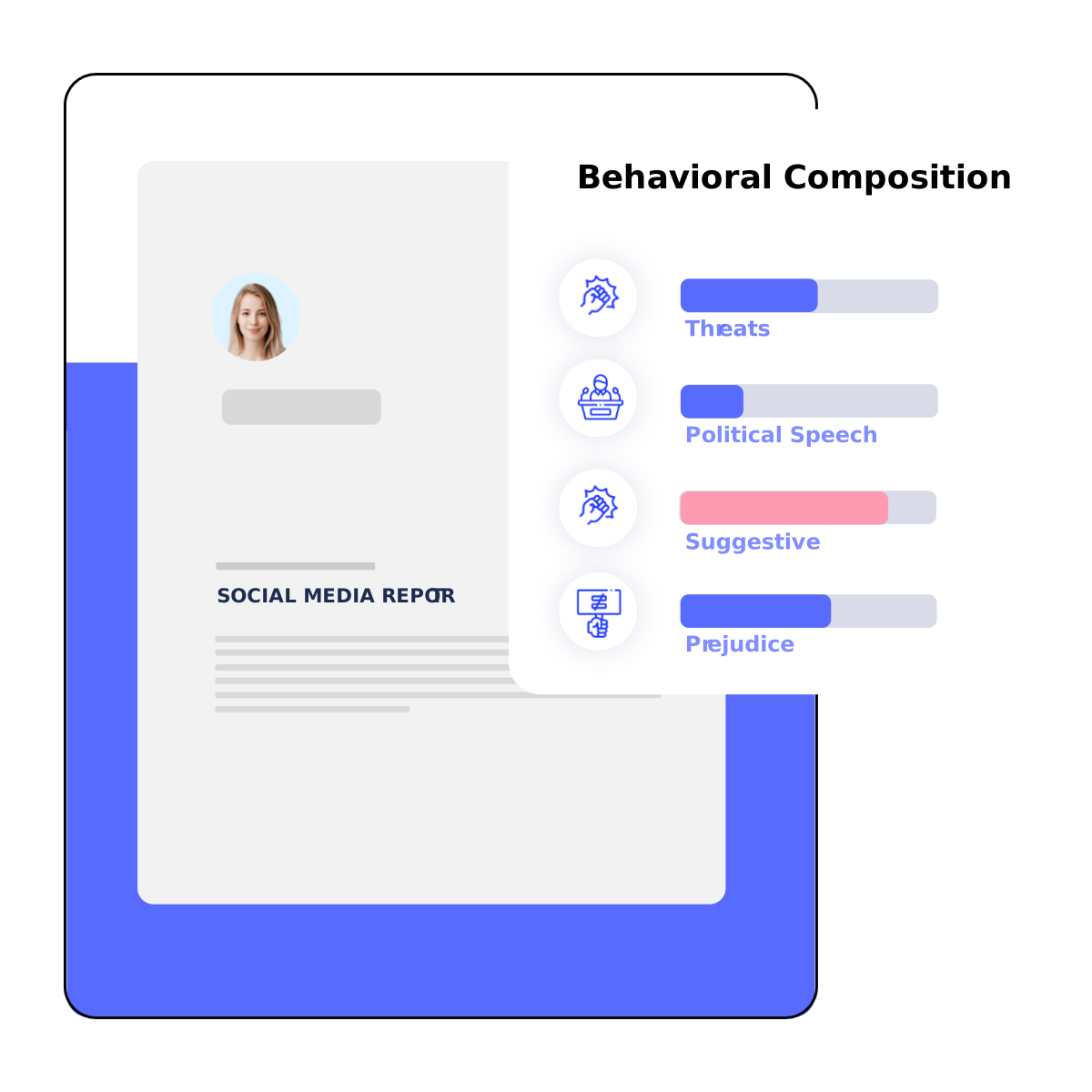
When calibrated correctly, AI screenings can help identify creators who push boundaries in productive ways without mistaking distinctive behavior for future PR risk. Ferretly's behavioral analysis helps distinguish creative nonconformity from actual reputational risk – protecting innovation without stifling it.
2. The Eccentricity That Built Hollywood
Would Tarantino pass a modernAI screening? We all hope so. Hollywood has long been shaped by creators with bold visions, strange habits, and unconventional lives. As Scientific American notes, "Creativity and eccentricity often go hand in hand," rooted in how the brain filters information.
Hollywood's most impactful work often comes from people who think differently both on-screen and off. These neurological differences can produce masterpieces – or missteps – and AI's job is to discern between the two, not flatten them.
3. Decoding Creativity – What Data Really Reveals
Advances in neuroscience show creativity is not random chaos; it arises from the interplay between imagination and cognitive control. Research from SciTechDaily demonstrates that distinct brain networks activate when people generate new ideas.
AI models can learn to detect signals of creative thinking without mistaking nonconformity for danger. By decoding creativity through patterns and data, AI can elevate the nextTarantino instead of screening him out.
4. When Innovation Looks Like Error
Creative minds break patterns others follow. Psychologists have found that eccentricity and creativity share neurological roots, which explains why unconventional thinkers may appear unpredictable. What seems like instability to an algorithm could actually be the spark of originality.
As AI evolves, its task is not to eliminate "odd" signals – but to ask why they appear. Sometimes the unexpected is precisely the beginning of innovation.
5. The Future of Creativity Is Human + Machine
The next wave of creative work will come from collaboration, not competition. AI can analyze thousands of datapoints and surface unseen connections, while humans bring the emotion, intuition, and imagination no system can replicate. Together, they accelerate creativity.
6. All in all…
If Quentin Tarantino applied today, an AI model might pause at his eccentricity – but with the right design, it shouldn't. True originality doesn't fit neatly into data fields, yet AI has the potential to recognize creativity without silencing it.
Maybe the real question isn't "Would Tarantino pass?", it's "Can AI rise to the challenge of identifying what makes a Tarantino possible?"
###
About This Article
This piece was developed as part of a University of Maryland writing practicum exploring AI ethics, responsible AI-assisted content creation, and advanced prompting techniques. The course was led by Adam Lloyd, Ph.D., with industry mentorship provided by Ferretly to ground coursework in real-world application and ethical AI use.
Student Author: Amanda Sartori
→amandacs@terpmail.umd.edu · LinkedIn
Course Faculty & Mentorship
Adam Lloyd, Ph.D. · Lecturer, University of Maryland
Adam teaches business and technical writing with a focus on real-world application—his courses partner with companies to create actual workplace deliverables. He co-created UMD's "Digital Rhetoric at the Dawn ofExtra-Human Discourse," exploring AI's role in academic, creative, and professional writing. A former journalist, startup founder, and award-honored educator, he holds advanced degrees in English, philosophy, and national security studies.
→lloyda@umd.edu · LinkedIn
Nicole Young · VP, Growth Marketing
Nicole provides industry mentorship for this course, bringing deep experience in growth marketing, advertising strategy, and AI-integrated content systems. Her work focuses on building ethical, scalable marketing programs at the intersection of technology, trust, and brand performance. She welcomes collaboration with academic programs seeking practitioner partnerships.
→nicole@ferretly.com · LinkedIn